THE REAL DIRTY BOMBS: DEPLETED URANIUM
by Christopher Bollyn
Lost in the media circus about the Iraq war, supposedly being fought to prevent a tyrant from obtaining weapons of mass destruction, is the salient fact that the United States and Britain are actively waging chemical and nuclear warfare in Iraq – using depleted uranium munitions.
The corporate-controlled press has failed to inform the public that, in spite of years of UN inspections and numerous international treaties, tons of banned weapons of mass destruction (WMD) – used and unused – remain in Iraq. Indeed, both chemical and radioactive WMD have been – and continue to be used against U.S. and coalition soldiers.
The media silence surrounding these banned WMD, and the horrendous consequences of their use, is due to the simple fact that they are being used by the U.S.-led coalition. They are the new “Silver Bullet” in the U.S. arsenal. They are depleted uranium weapons.
Depleted uranium (DU) weapons were first used during the first Gulf War against Iraq in 1991. The Pentagon estimated that between 315 and 350 tons of DU were fired during the first Gulf War. During the 2003 invasion and current occupation of Iraq, U.S. and British troops have reportedly used more than five times as many DU bombs and shells as the total number used during the 1991 war.
While the use of DU weapons and their effect on human health and the environment are subjects of extreme importance the Pentagon is noticeably reluctant to discuss these weapons. Despite numerous calls to specific individuals identified as being the appointed spokesmen on the subject, not one would answer their phone during normal business hours for the purpose of this article.
Dr. Doug Rokke, on the other hand, former director of the U.S. Army’s Depleted Uranium Project, is very willing to talk about the effects of DU. Rokke was involved in the “clean up” of 34 Abrams tanks and Bradley armored vehicles hit by friendly fire during the 1991 Gulf War. Today he suffers from the ill effects of DU in his body.
Rokke told American Free Press that the Pentagon uses DU weapons because they are the most effective at killing and destroying everything they hit. The highest level of the U.S. and British governments have “totally disregarded the consequences” of the use of DU weapons, Rokke said.
The first Gulf War was the largest friendly fire incident in the history of American warfare, Rokke says. “The majority of the casualties were the result of friendly fire,” he told AFP.
DU is used in many forms of ammunition as an armor penetrator because of its extreme weight and density. The uranium used in these missiles and bombs is a by-product of the nuclear enrichment process. Experts say the Department of Energy has 100 million tons of DU and using it in weapons saves the government money on the cost of its disposal.
Rather than disposing of the radioactive waste, it is shaped into penetrator rods used in the billions of rounds being fired in Iraq and Afghanistan. The radioactive waste from the U.S. nuclear weapons industry has, in effect, been forcibly exported and spread in the environments of Iraq, Afghanistan, the former Yugoslavia, Puerto Rico, and elsewhere.
THE REAL “DIRTY BOMBS”
“A flying rod of solid uranium 18-inches long and three-quarters of an inch in diameter,” is what becomes of a DU tank round after it is fired, Rokke said. Because Uranium-238 is pyrophoric, meaning it burns on contact with air, DU rounds are burning as they fly.
When the DU penetrator hits an object it breaks up and causes secondary explosions, Rokke said. “It’s way beyond a dirty bomb,” Rokke said, referring to the terror weapon that uses conventional explosives to spread radioactive material.Some of the uranium used with DU weapons vaporizes into extremely small particles, which are dispersed into the atmosphere where they remain until they fall to the ground with the rain. As a gas, the chemically toxic and radioactive uranium can easily enter the body through the skin or the lungs and be carried around the world until it falls to earth with the rain.
AFP asked Marion Falk, a retired chemical physicist who built nuclear bombs for more than 20 years at Lawrence Livermore lab, if he thought that DU weapons operate in a similar manner as a dirty bomb. “That’s exactly what they are,” Falk said. “They fit the description of a dirty bomb in every way.”
According to Falk, more than 30 percent of the DU fired from the cannons of U.S. tanks is reduced to particles one-tenth of a micron (one millionth of a meter) in size or smaller on impact.“The larger the bang” the greater the amount of DU that is dispersed into the atmosphere, Falk said. With the larger missiles and bombs, nearly 100 percent of the DU is reduced to radioactive dust particles of the “micron size” or smaller, he said.
While the Pentagon officially denies the dangers of DU weapons, since at least 1943 the military has been aware of the extreme toxicity of uranium dispersed as a gas. A declassified memo written by James B. Conant and two other physicists working on the U.S. nuclear project during the Second World War, and sent to Brig. Gen. L.R. Groves on October 30, 1943, provides the evidence:
“As a gas warfare instrument the [radioactive] material would be ground into particles of microscopic size to form dust and smoke and distributed by a ground-fired projectile, land vehicles, or aerial bombs,” the 1943 memo reads. “In this form it would be inhaled by personnel. The amount necessary to cause death to a person inhaling the material is extremely small. It has been estimated that one millionth of a gram accumulation in a person’s body would be fatal. There are no known methods of treatment for such a casualty.”
The use of radioactive materials “as a terrain contaminant” to “deny terrain to either side except at the expense of exposing personnel to harmful radiations” is also discussed in the Groves memo of 1943.
“Anybody, civilian or soldier, who breathes these particles has a permanent dose, and it’s not going to decrease very much over time,” Leonard Dietz, a retired nuclear physicist with 33 years experience told the New York Daily News. “In the long run … veterans exposed to ceramic uranium oxide have a major problem.”
Inhaled particles of radioactive uranium oxide dust will either lodge in the lungs or travel through the body, depending on their size. The smallest particles can be carried through cell walls and “affect the master code - the _expression of the DNA,” Falk told AFP.
Inhaled DU can “fool around with the keys” and do damage to “practically anything,” Falk said. “It affects the body in so many ways and there are so many different symptoms that they want to give it different names,” Falk said about the wide variety of ailments afflicting Gulf War veterans.
Today, more than one out of every three veterans from the first Gulf War are permanently disabled. Terry Jemison of the Dept. of Veterans Affairs said that of the 592,561 discharged veterans from the 1991 war in Iraq, 179,310 are receiving disability compensation and another 24,763 cases are pending.
The “epigenetic damage” done by DU has resulted in many grossly deformed children born in areas such as southern Iraq where tons of DU have contaminated the environment and local population. An untold number of Americans have also been born with severe birth defects as a result of DU contamination.
The New York Daily News conducted a study on nine recently returned soldiers from the New York National Guard. Four of the nine were found to have “almost certainly” inhaled radioactive dust from exploded DU shells.
Laboratory tests revealed two manmade forms of uranium in urine samples from four of the 9 soldiers. The four soldiers are the first confirmed cases of inhaled DU from the current Iraq war.
“These are amazing results, especially since these soldiers were military police not exposed to the heat of battle,” said Dr. Asaf Duracovic, who examined the soldiers and performed the testing. “Other American soldiers who were in combat must have more DU exposure,” Duracovic said. Duracovic is a colonel in the Army reserves and served in the 1991 Gulf War.
The test results showing that four of nine New York guardsmen test positive for DU “suggest the potential for more extensive radiation exposure among coalition troops and Iraqi civilians,” the Daily News reported.
“A large number of American soldiers [in Iraq] may have had significant exposure to uranium oxide dust,” Dr. Thomas Fasey, a pathologist at Mount Sinai Medical Center and an expert on depleted uranium said, “And the health impact is worrisome for the future.”
HOTTER THAN HELL
“I’m hotter than hell,” Rokke told AFP. The Dept. of Energy tested Rokke in 1994 and found that he was excreting more than 5,000 times the permissible level of depleted uranium. Rokke, however, was not informed of the results until 1996.
As director of the Depleted Uranium Project in 1994-95, Rokke said his task was three fold: determine how to provide medical care for DU victims, how to clean it up, and how to educate and train personnel using DU weapons.
Today, Rokke says that DU cannot be cleaned up and there is no medical care. “Once you’re zapped – you’re zapped,” Rokke said. Among the health problems Rokke is suffering as a result of DU contamination is brittle teeth. He said that he just paid out $400 for an operation for teeth that have broken off. “The uranium replaces the calcium in your teeth and bones,” Rokke said
.“You fight for medical care every day of your life,” he said.
“There are over 30,000 casualties from this Iraq war,” Rokke said.
The three tasks set out for the Depleted Uranium Project have all failed, Rokke said. He wants to know why medical care is not being provided for all the victims of DU and why the environment is not being cleaned up.
“They have to be held accountable,” Rokke said, naming President George W. Bush, Secretary of Defense Donald Rumsfeld, and British prime minister Tony Blair. They chose to use DU weapons and “totally disregarded the consequences.”
Christopher Bollyn
Article republished courtesy of American Free Press http://www.americanfreepress.net
Photo of an Iraqi child victim of D.U., courtesy of Dave’s Web: The Center for an Informed America: Newsletter #13 August 13, 2002; http://davesweb.cnchost.com/nwsltr13.html
Please also see:
Cancer Epidemic Caused by U.S. WMDM.D. Says Depleted Uranium Definitively LinkedBy Christopher Bollyn http://www.americanfreepress.net/html/cancer_epidemic_.html
THE TINY VICTIMS OF DESERT STORM
When our soldiers risked their lives in the Gulf, they never imagined that their children might suffer the consequences--or that their country would turn its back on them. Photography by Derek Hudson Text by Kenneth Miller Reporting by Jimmie Briggs Jayce Hanson's birth defects may stem from his father's Gulf War service. But like hundreds of other families, the Hansons face official stonewalling--and a frightening future. http://www.life.com/Life/essay/gulfwar/gulf01.html
Effects of Wars on IraqDr Jawad Al-Ali, oncologist (tumor specialist) of Basrah, Iraq. Slides - http://216.138.195.197/pdf/Effects-of-DU-war.pdf Video - mms://216.138.195.197/Effects%20of%20DU%20War%20in%20Basrah
With thanks to Ross Wilcock and Leuren Moret for drawing the video and slides to our attention.
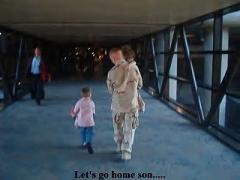
'Let's go home son' is how we captioned the photo
Tuesday, August 31, 2004


Thursday, August 26, 2004
Beware what you're not aware of,
see original at http://nationalcatholicreporter.org/fwis/fw082604.htm
Beware what you're not aware of, it measures your humanity
By Joan Chittister, OSB
August 25 has been designated by the Save Dafur Coalition (see related story) as a Sudanese awareness day or "Sudan: Day of Conscience." Right. It raises serious conscience questions for us all:
The first important question, I suppose, is how many people are even aware of the awareness day?
The second question is what is the Sudanese situation about anyway?
And the third question is what does any of it have to do with us?
The first two answers, tragic as they may be, are at least obvious.
The third one, basic as it may be to our own future, to our own humanity, is not.
The first answer is undeniable. I'm not sure how many people are aware of the Day of Conscience, but I know how many should be: Everyone of us who call ourselves human should be. Everyone of us who call ourselves moral should be. All of us should be.
A tragedy of massive import is going on in the human family, and we don't even know it. We're too involved in a tragedy of our own making in Iraq -- trying to minimize it, trying to justify it, trying to forget it. The tragedy in Sudan hardly makes our papers. In fact, Iraq hardly makes our papers anymore. We don't know how many Iraqis are dead; we don't know how many of our own soldiers are wounded. The last thing in the world we want to do is to burden our psyches with one more ounce of proof that violence only begets violence.
But we can't ignore this great inhuman dimension of our humanity much longer. The truth is that it has as much to do with who we are as a people as with who they are as a people.
The United Nations calls the situation in Sudan "the world's worst humanitarian crisis" and says the Janjaweed militia is waging "ethnic cleansing" there. The genocide of the entire black population is, in fact, now at stake.
World Watch Institute tells us that over 200,000 black Sudanese have been murdered by this government-supported militia, thugs who have government approval to do what the government does not want to be seen doing.
Another 1.2 million people have fled their villages to save their lives. They are either wandering and homeless or are homeless and living in refugee camps without water, without sanitation, without food.
Most of the men in the villages were murdered, most of the women were brutally raped there and go on being raped by the very guards "guarding" them even in the refugee camps. Women's bodies, like nuclear bombs, are men's newest weapons of mass destruction.
To do nothing now about this when one of the major reasons we give for invading Iraq is because of what Saddam Hussein did to the Kurds more than 10 years ago seems almost ludicrous. We must be missing something here. But what could it be?
The answer to the second question is clear, too: The war is about about racism, about religion, about oil - all the usual excuses we give when what we really want is dominance.
War has been raging in the Sudan since 1983. The government, dominated by Arabs from the country's north, has wanted to impose sharia law on the Christian and animist populations of the south and subjugate the black African Muslims of the west. On the side, of course, the government also wants control of the land and water of the west and the oil in the south.
All these things are real and all these things are stoppable if the world really set out to stop them. But we don't. And that question is why?
The answer to the third question, what does any of this have to do with us, is the hardest question of all to answer -- not because we don't know the answer, certainly, but because we don't want to face it in ourselves, perhaps.
The answer to the third question is that we love warriors. And wars will never end until the world stops adoring its warriors.
We are waging a presidential election in this country at this very moment, the major issue of which seems to be who of these two men is the greatest warrior? The one who didn't go to war at all but started his own or the one who went to war only to come back to tell us that going to that war was wrong?
But why are we asking ourselves which one of them is strong enough to fight and not asking ourselves which one of them is strong enough not to fight? Why aren't we asking ourselves which one of them is strong enough to find another way to settle conflicts, strong enough to stop playing the politics of fear, strong enough to cease and desist from spending our lives, and the lives of our children, on power and destruction?
After all, most of the people of the world don't even have the option of fighting. They don't have the weapons, they don't have the resources, they don't have the population, and they don't have the means to blow up the world while we spend most of our national wealth assuring ourselves that we can.
From where I stand, it seems that we badly need a Day of Conscience, a Day of Awareness in our lives.
We need a moment when we stand at a great distance from human inhumanity at its ultimate and ask ourselves what it is in us that makes us more interested in choosing a warrior president than we are in electing a president who will make the country strong in health care, strong in education, strong in civil rights, strong in international relations, strongly involved in an international military police force that would stop the killing, stop the raping, stop the burning of the villages, stop the massacres and stop the forcible depopulation of an entire strain of people everywhere tomorrow -- in Darfur, Sudan, today.
By all means, be aware, have conscience.What you see may tell you as much about ourselves and our future as it tells us about the Sudan.
Comments or questions about this column may be sent to: fwis@nationalcatholicreporter.org
--------------------------------------------------------------------------------
Copyright © 2004 The National Catholic Reporter Publishing Company, 115 E. Armour Blvd., Kansas City, MO 64111 All rights reserved. TEL: 1-816-531-0538 FAX: 1-816-968-2280
FAIR USE NOTICE This site contains copyrighted material the use of which has not always been specifically authorized by the copyright owner. We are making such material available in our efforts to advance understanding of environmental, political, human rights, economic, democracy, scientific, and social justice issues, etc. We believe this constitutes a 'fair use' of any such copyrighted material as provided for in section 107 of the US Copyright Law. In accordance with Title 17 U.S.C. Section 107, the material on this site is distributed without profit to those who have expressed a prior interest in receiving the included information for research and educational purposes. For more information go to: http://www.law.cornell.edu/uscode/17/107.shtml. If you wish to use copyrighted material from this site for purposes of your own that go beyond 'fair use', you must obtain permission from the copyright owner.
Beware what you're not aware of, it measures your humanity
By Joan Chittister, OSB
August 25 has been designated by the Save Dafur Coalition (see related story) as a Sudanese awareness day or "Sudan: Day of Conscience." Right. It raises serious conscience questions for us all:
The first important question, I suppose, is how many people are even aware of the awareness day?
The second question is what is the Sudanese situation about anyway?
And the third question is what does any of it have to do with us?
The first two answers, tragic as they may be, are at least obvious.
The third one, basic as it may be to our own future, to our own humanity, is not.
The first answer is undeniable. I'm not sure how many people are aware of the Day of Conscience, but I know how many should be: Everyone of us who call ourselves human should be. Everyone of us who call ourselves moral should be. All of us should be.
A tragedy of massive import is going on in the human family, and we don't even know it. We're too involved in a tragedy of our own making in Iraq -- trying to minimize it, trying to justify it, trying to forget it. The tragedy in Sudan hardly makes our papers. In fact, Iraq hardly makes our papers anymore. We don't know how many Iraqis are dead; we don't know how many of our own soldiers are wounded. The last thing in the world we want to do is to burden our psyches with one more ounce of proof that violence only begets violence.
But we can't ignore this great inhuman dimension of our humanity much longer. The truth is that it has as much to do with who we are as a people as with who they are as a people.
The United Nations calls the situation in Sudan "the world's worst humanitarian crisis" and says the Janjaweed militia is waging "ethnic cleansing" there. The genocide of the entire black population is, in fact, now at stake.
World Watch Institute tells us that over 200,000 black Sudanese have been murdered by this government-supported militia, thugs who have government approval to do what the government does not want to be seen doing.
Another 1.2 million people have fled their villages to save their lives. They are either wandering and homeless or are homeless and living in refugee camps without water, without sanitation, without food.
Most of the men in the villages were murdered, most of the women were brutally raped there and go on being raped by the very guards "guarding" them even in the refugee camps. Women's bodies, like nuclear bombs, are men's newest weapons of mass destruction.
To do nothing now about this when one of the major reasons we give for invading Iraq is because of what Saddam Hussein did to the Kurds more than 10 years ago seems almost ludicrous. We must be missing something here. But what could it be?
The answer to the second question is clear, too: The war is about about racism, about religion, about oil - all the usual excuses we give when what we really want is dominance.
War has been raging in the Sudan since 1983. The government, dominated by Arabs from the country's north, has wanted to impose sharia law on the Christian and animist populations of the south and subjugate the black African Muslims of the west. On the side, of course, the government also wants control of the land and water of the west and the oil in the south.
All these things are real and all these things are stoppable if the world really set out to stop them. But we don't. And that question is why?
The answer to the third question, what does any of this have to do with us, is the hardest question of all to answer -- not because we don't know the answer, certainly, but because we don't want to face it in ourselves, perhaps.
The answer to the third question is that we love warriors. And wars will never end until the world stops adoring its warriors.
We are waging a presidential election in this country at this very moment, the major issue of which seems to be who of these two men is the greatest warrior? The one who didn't go to war at all but started his own or the one who went to war only to come back to tell us that going to that war was wrong?
But why are we asking ourselves which one of them is strong enough to fight and not asking ourselves which one of them is strong enough not to fight? Why aren't we asking ourselves which one of them is strong enough to find another way to settle conflicts, strong enough to stop playing the politics of fear, strong enough to cease and desist from spending our lives, and the lives of our children, on power and destruction?
After all, most of the people of the world don't even have the option of fighting. They don't have the weapons, they don't have the resources, they don't have the population, and they don't have the means to blow up the world while we spend most of our national wealth assuring ourselves that we can.
From where I stand, it seems that we badly need a Day of Conscience, a Day of Awareness in our lives.
We need a moment when we stand at a great distance from human inhumanity at its ultimate and ask ourselves what it is in us that makes us more interested in choosing a warrior president than we are in electing a president who will make the country strong in health care, strong in education, strong in civil rights, strong in international relations, strongly involved in an international military police force that would stop the killing, stop the raping, stop the burning of the villages, stop the massacres and stop the forcible depopulation of an entire strain of people everywhere tomorrow -- in Darfur, Sudan, today.
By all means, be aware, have conscience.What you see may tell you as much about ourselves and our future as it tells us about the Sudan.
Comments or questions about this column may be sent to: fwis@nationalcatholicreporter.org
--------------------------------------------------------------------------------
Copyright © 2004 The National Catholic Reporter Publishing Company, 115 E. Armour Blvd., Kansas City, MO 64111 All rights reserved. TEL: 1-816-531-0538 FAX: 1-816-968-2280
FAIR USE NOTICE This site contains copyrighted material the use of which has not always been specifically authorized by the copyright owner. We are making such material available in our efforts to advance understanding of environmental, political, human rights, economic, democracy, scientific, and social justice issues, etc. We believe this constitutes a 'fair use' of any such copyrighted material as provided for in section 107 of the US Copyright Law. In accordance with Title 17 U.S.C. Section 107, the material on this site is distributed without profit to those who have expressed a prior interest in receiving the included information for research and educational purposes. For more information go to: http://www.law.cornell.edu/uscode/17/107.shtml. If you wish to use copyrighted material from this site for purposes of your own that go beyond 'fair use', you must obtain permission from the copyright owner.
'His Scream' Father learns death of soldier son in Iraq
'His Scream’
Marine’s Father Burns Van, Himself After Learning of Son’s Death in Iraq
ABCNEWS.com
H O L L Y W O O D, Fla., Aug. 26, 2004— Melida Arredondo said her husband, Carlos Arredondo, immediately fell apart when he saw three Marines approaching his home.
"My husband immediately knew that his firstborn son had been killed," Arredondo said on ABC News' Good Morning America.
The three Marines showed up at Arredondo's home to inform the family that Lance Cpl. Alexander Arredondo, 20, had died Tuesday in Najaf.
What happened next shocked the Marines and Arredondo's neighbors.
After getting the news, Carlos Arredondo walked into the garage, picked up a propane tank, a lighting device and a can of gasoline. He then proceeded to set the Marines' van ablaze while he was inside.
"I went to pieces and my husband, as you know, went to pieces and basically tried to accompany his son," Melida Arredondo, Alex's stepmother, said.
The Marines were eventually able to pull Carlos Arredondo from the burning vehicle. While they extinguished the flames that had engulfed him, the distraught father still suffered burns over as much as 50 percent of his body.
Arredondo, 44, was initially taken to Memorial Regional Hospital in Hollywood. He was later moved to the major burn unit at Jackson Memorial Hospital in Miami, about 20 miles south of Hollywood.
He was listed in serious condition with severe burns to his arms and legs.
The Marines, reservists who are members of a military Casualty Assistance Calls Officer team, were not injured, but the van was completely gutted.
"Every reaction is negative, it's the loss of a loved one and I don't think any of us are qualified to go into the depths of the mind and truly anticipate how somebody is going to react," Marines spokesman Maj. Scott Mack said.
Melida Arredondo said her husband's reaction was about more than just sheer emotion.
"This was his scream that his Chi-Chi — that's what he called Alex — this is his scream that his child is dead and the war needs to stop," she said. Authorities say they are concerned about Arredondo's recovery right now. It's unclear whether he will be charged with any crime.
U.S. forces in Najaf have been battling for nearly five months against Iraqi militiamen loyal to radical Shiite cleric Muqtada al-Sadr.
http://www.abcnews.go.com/sections/GMA/US/Marine_Father_Fire_040826-1.html
Marine’s Father Burns Van, Himself After Learning of Son’s Death in Iraq
ABCNEWS.com
H O L L Y W O O D, Fla., Aug. 26, 2004— Melida Arredondo said her husband, Carlos Arredondo, immediately fell apart when he saw three Marines approaching his home.
"My husband immediately knew that his firstborn son had been killed," Arredondo said on ABC News' Good Morning America.
The three Marines showed up at Arredondo's home to inform the family that Lance Cpl. Alexander Arredondo, 20, had died Tuesday in Najaf.
What happened next shocked the Marines and Arredondo's neighbors.
After getting the news, Carlos Arredondo walked into the garage, picked up a propane tank, a lighting device and a can of gasoline. He then proceeded to set the Marines' van ablaze while he was inside.
"I went to pieces and my husband, as you know, went to pieces and basically tried to accompany his son," Melida Arredondo, Alex's stepmother, said.
The Marines were eventually able to pull Carlos Arredondo from the burning vehicle. While they extinguished the flames that had engulfed him, the distraught father still suffered burns over as much as 50 percent of his body.
Arredondo, 44, was initially taken to Memorial Regional Hospital in Hollywood. He was later moved to the major burn unit at Jackson Memorial Hospital in Miami, about 20 miles south of Hollywood.
He was listed in serious condition with severe burns to his arms and legs.
The Marines, reservists who are members of a military Casualty Assistance Calls Officer team, were not injured, but the van was completely gutted.
"Every reaction is negative, it's the loss of a loved one and I don't think any of us are qualified to go into the depths of the mind and truly anticipate how somebody is going to react," Marines spokesman Maj. Scott Mack said.
Melida Arredondo said her husband's reaction was about more than just sheer emotion.
"This was his scream that his Chi-Chi — that's what he called Alex — this is his scream that his child is dead and the war needs to stop," she said. Authorities say they are concerned about Arredondo's recovery right now. It's unclear whether he will be charged with any crime.
U.S. forces in Najaf have been battling for nearly five months against Iraqi militiamen loyal to radical Shiite cleric Muqtada al-Sadr.
http://www.abcnews.go.com/sections/GMA/US/Marine_Father_Fire_040826-1.html
Wednesday, August 25, 2004
Made in Iraq: The New Antiwar Veteran
Made in Iraq: The New Antiwar Veteran
by Robert J. Lifton
ON THE FRINGE of the recent Democratic National Convention in Boston, there was a miniconvention of a group called Veterans for Peace. Most of the 400-plus participants were Vietnam veterans, though there were smaller contingents of veterans of World War II, the Korean War, and the first Gulf War. But the most dramatic presence was that of a group of new kids on the block, veterans of the war in Iraq. These new veterans could come to have a powerful influence on our country. Iraq veterans undergo the same psychological struggles of all survivors over images of deaths , how much to feel and not to feel, pain and guilt from the deaths of buddies and their own behavior. Above all, war survivors hunger for meaning -- for some kind of moral judgment about their encounters with death.
In this quest for understanding, it turns out that Iraq veterans have much in common with their older compatriots who fought in Vietnam. Both groups were involved in a confusing counterinsurgency war conducted in an alien, hostile environment against a nonwhite enemy as elusive as he was dangerous. The result in both cases was an atrocity-producing situation -- one structured militarily and psychologically so that ordinary soldiers with no special history of violence or antisocial behavior were suddenly capable of killing or torturing civilians who were loosely designated as "the enemy."
A significant number of Vietnam veterans found meaning in opposing their war while it was in progress. The hearings on American war crimes and the throwing away of medals were their way of rejecting the war and holding not just themselves but their country accountable.
Their impact on the nation was different from that of other antiwar protesters because they were able to bring the Vietnam death scene directly to the American public, as John Kerry did in his 1971 testimony before a US Senate subcommittee, when he asked, "How we can ask a man to be the last man to die for a mistake?"
What Kerry and other antiwar veterans were contesting was the wartime tradition that in order to make sure the fallen did not "die in vain," one must rally round the flag, assert the nobility of the cause, and prosecute the war ever more vigorously.Instead, they invoked the authority of the dead to oppose rather than perpetuate the war.
This kind of alternative is by no means new -- it was powerfully expressed by writers surviving World War I and goes back as far as Homer.
Iraq veterans are beginning to express similar sentiments. In Boston they sounded not unlike their Vietnam predecessors. They emphasized the large-scale killing of Iraqi civilians by American firepower, along with their own widespread confusion. "We were lost. We had no idea what we were doing," was the way one put it.
These veterans formed a new organization at the convention, Iraq Veterans Against the War, modeled on the earlier Vietnam Veterans Against the War. It is too early to say how many will join this new group; much depends on what happens in Iraq and on the extent of antiwar opposition at home.
But there is already a personal and primal connection between veterans of Vietnam and Iraq: They are literally fathers and sons or daughters. Generational transmission of war experience has always had enormous psychological importance. Men who fought in Vietnam told me decades ago of having heard, on their fathers' knees, tales of courage and heroism in fighting the "good war." Those World War II fathers were often perplexed and angered by their sons' disillusionment with and bitter opposition to their own war. But Vietnam veteran fathers may have no such difficulty with the disillusionment of their children.
The sharing of an antiwar sentiment may indeed be a powerful bond. That was the case with an Iraq veteran, the daughter of a Vietnam veteran, who spoke at the meeting of the extreme chaos in which neither Americans nor Iraqis could be "protected" and of her constant question of "what we were doing there."
American soldiers fighting in Iraq are also saying things reminiscent of their Vietnam veteran fathers and uncles. The British newspaper The Guardian reported American soldiers as saying: "It's really frustrating cause I mean we can't find these guys. They shoot at us all the time, they run away, we try to figure out who it is, we interrogate people -- do they know who it was? No, nobody knows who it was"; and "This is the last place I'd probably ever want to die"; and "I don't have any idea of what we're trying to do out here. I don't know what the [goal] is, and I don't think our commanders do either."
These feelings arise from the war in Iraq. But the Vietnam experience hovers over everything; it is reactivated by what we hear about Iraq. In that sense a shared parent-child antiwar sentiment may come to reverberate throughout society. We have not heard the last of this poignant generational alliance.
Robert J. Lifton is a lecturer in psychiatry at Harvard Medical School and author, most recently, of "Superpower Syndrome: America's Apocalyptic Confrontation with the World."
© Copyright 2004 Globe Newspaper Company.
FAIR USE NOTICE
This site contains copyrighted material the use of which has not always been specifically authorized by the copyright owner. We are making such material available in our efforts to advance understanding of environmental, political, human rights, economic, democracy, scientific, and social justice issues, etc. We believe this constitutes a 'fair use' of any such copyrighted material as provided for in section 107 of the US Copyright Law. In accordance with Title 17 U.S.C. Section 107, the material on this site is distributed without profit to those who have expressed a prior interest in receiving the included information for research and educational purposes. For more information go to: http://www.law.cornell.edu/uscode/17/107.shtml. If you wish to use copyrighted material from this site for purposes of your own that go beyond 'fair use', you must obtain permission from the copyright owner.
_________________________________________________________________________________
Visit their website; Iraq Veterans Against the War at
http://www.ivaw.net/
__________________________________________________
by Robert J. Lifton
ON THE FRINGE of the recent Democratic National Convention in Boston, there was a miniconvention of a group called Veterans for Peace. Most of the 400-plus participants were Vietnam veterans, though there were smaller contingents of veterans of World War II, the Korean War, and the first Gulf War. But the most dramatic presence was that of a group of new kids on the block, veterans of the war in Iraq. These new veterans could come to have a powerful influence on our country. Iraq veterans undergo the same psychological struggles of all survivors over images of deaths , how much to feel and not to feel, pain and guilt from the deaths of buddies and their own behavior. Above all, war survivors hunger for meaning -- for some kind of moral judgment about their encounters with death.
In this quest for understanding, it turns out that Iraq veterans have much in common with their older compatriots who fought in Vietnam. Both groups were involved in a confusing counterinsurgency war conducted in an alien, hostile environment against a nonwhite enemy as elusive as he was dangerous. The result in both cases was an atrocity-producing situation -- one structured militarily and psychologically so that ordinary soldiers with no special history of violence or antisocial behavior were suddenly capable of killing or torturing civilians who were loosely designated as "the enemy."
A significant number of Vietnam veterans found meaning in opposing their war while it was in progress. The hearings on American war crimes and the throwing away of medals were their way of rejecting the war and holding not just themselves but their country accountable.
Their impact on the nation was different from that of other antiwar protesters because they were able to bring the Vietnam death scene directly to the American public, as John Kerry did in his 1971 testimony before a US Senate subcommittee, when he asked, "How we can ask a man to be the last man to die for a mistake?"
What Kerry and other antiwar veterans were contesting was the wartime tradition that in order to make sure the fallen did not "die in vain," one must rally round the flag, assert the nobility of the cause, and prosecute the war ever more vigorously.Instead, they invoked the authority of the dead to oppose rather than perpetuate the war.
This kind of alternative is by no means new -- it was powerfully expressed by writers surviving World War I and goes back as far as Homer.
Iraq veterans are beginning to express similar sentiments. In Boston they sounded not unlike their Vietnam predecessors. They emphasized the large-scale killing of Iraqi civilians by American firepower, along with their own widespread confusion. "We were lost. We had no idea what we were doing," was the way one put it.
These veterans formed a new organization at the convention, Iraq Veterans Against the War, modeled on the earlier Vietnam Veterans Against the War. It is too early to say how many will join this new group; much depends on what happens in Iraq and on the extent of antiwar opposition at home.
But there is already a personal and primal connection between veterans of Vietnam and Iraq: They are literally fathers and sons or daughters. Generational transmission of war experience has always had enormous psychological importance. Men who fought in Vietnam told me decades ago of having heard, on their fathers' knees, tales of courage and heroism in fighting the "good war." Those World War II fathers were often perplexed and angered by their sons' disillusionment with and bitter opposition to their own war. But Vietnam veteran fathers may have no such difficulty with the disillusionment of their children.
The sharing of an antiwar sentiment may indeed be a powerful bond. That was the case with an Iraq veteran, the daughter of a Vietnam veteran, who spoke at the meeting of the extreme chaos in which neither Americans nor Iraqis could be "protected" and of her constant question of "what we were doing there."
American soldiers fighting in Iraq are also saying things reminiscent of their Vietnam veteran fathers and uncles. The British newspaper The Guardian reported American soldiers as saying: "It's really frustrating cause I mean we can't find these guys. They shoot at us all the time, they run away, we try to figure out who it is, we interrogate people -- do they know who it was? No, nobody knows who it was"; and "This is the last place I'd probably ever want to die"; and "I don't have any idea of what we're trying to do out here. I don't know what the [goal] is, and I don't think our commanders do either."
These feelings arise from the war in Iraq. But the Vietnam experience hovers over everything; it is reactivated by what we hear about Iraq. In that sense a shared parent-child antiwar sentiment may come to reverberate throughout society. We have not heard the last of this poignant generational alliance.
Robert J. Lifton is a lecturer in psychiatry at Harvard Medical School and author, most recently, of "Superpower Syndrome: America's Apocalyptic Confrontation with the World."
© Copyright 2004 Globe Newspaper Company.
FAIR USE NOTICE
This site contains copyrighted material the use of which has not always been specifically authorized by the copyright owner. We are making such material available in our efforts to advance understanding of environmental, political, human rights, economic, democracy, scientific, and social justice issues, etc. We believe this constitutes a 'fair use' of any such copyrighted material as provided for in section 107 of the US Copyright Law. In accordance with Title 17 U.S.C. Section 107, the material on this site is distributed without profit to those who have expressed a prior interest in receiving the included information for research and educational purposes. For more information go to: http://www.law.cornell.edu/uscode/17/107.shtml. If you wish to use copyrighted material from this site for purposes of your own that go beyond 'fair use', you must obtain permission from the copyright owner.
_________________________________________________________________________________
Visit their website; Iraq Veterans Against the War at
http://www.ivaw.net/
__________________________________________________
God is Not a Republican. God is Not a Democrat.
from Sojourners
http://www.sojo.net/
You know the saying that truth is stranger than fiction. When it comes to the Religious Right, we believe that truth is scarier than fiction.
Sojourners is outraged by claims that Christians can only vote for George W. Bush and that Bush is God's candidate. So we produced this animated Web video. Watch for yourself and see what several Religious Right leaders are actually saying.
Watch the video at: www.sojo.net/video
We also distributed a petition that has been signed by more than 25,000 people. It will appear as a full-page advertisement in The New York Times next week during the Republican convention - and in other local newspapers across America!
Every faithful citizen in America should know that they can choose to vote for any candidate - for reasons deeply rooted in their faith.
Let's tell America that the Religious Right doesn't speak for us. Let's take back our faith.
www.sojo.net/video
http://www.takebackourfaith.org/
These leaders of the Religious Right mistakenly claim that God has taken a side in this election, and that Christians should only vote for George W. Bush.
We believe that claims of divine appointment for the President, uncritical affirmation of his policies, and assertions that all Christians must vote for his re-election constitute bad theology and dangerous religion.
We believe that sincere Christians and other people of faith can choose to vote for President Bush or Senator Kerry - for reasons deeply rooted in their faith.
We believe all candidates should be examined by measuring their policies against the complete range of Christian ethics and values.
We will measure the candidates by whether they enhance human life, human dignity, and human rights; whether they strengthen family life and protect children; whether they promote racial reconciliation and support gender equality; whether they serve peace and social justice; and whether they advance the common good rather than only individual, national, and special interests.
We are not single-issue voters.
We believe that poverty - caring for the poor and vulnerable - is a religious issue. Do the candidates' budget and tax policies reward the rich or show compassion for poor families? Do their foreign policies include fair trade and debt cancellation for the poorest countries? (Matthew 25:35-40, Isaiah 10:1-2)
We believe that the environment - caring for God's earth - is a religious issue. Do the candidates' policies protect the creation or serve corporate interests that damage it? (Genesis 2:15, Psalm 24:1)
We believe that war - and our call to be peacemakers - is a religious issue. Do the candidates' policies pursue "wars of choice" or respect international law and cooperation in responding to real global threats? (Matthew 5:9)
We believe that truth-telling is a religious issue. Do the candidates tell the truth in justifying war and in other foreign and domestic policies? (John 8:32)
We believe that human rights - respecting the image of God in every person - is a religious issue. How do the candidates propose to change the attitudes and policies that led to the abuse and torture of Iraqi prisoners? (Genesis 1:27)
We believe that our response to terrorism is a religious issue. Do the candidates adopt the dangerous language of righteous empire in the war on terrorism and confuse the roles of God, church, and nation? Do the candidates see evil only in our enemies but never in our own policies? (Matthew 6:33, Proverbs 8:12-13 )
We believe that a consistent ethic of human life is a religious issue. Do the candidates' positions on abortion, capital punishment, euthanasia, weapons of mass destruction, HIV/AIDS-and other pandemics-and genocide around the world obey the biblical injunction to choose life? (Deuteronomy 30:19)
We also admonish both parties and candidates to avoid the exploitation of religion or our congregations for partisan political purposes.
By signing this statement, we call Christians and other people of faith to a more thoughtful involvement in this election, rather than claiming God's endorsement of any candidate.
This is the meaning of responsible Christian citizenship.
Founded in 1971, Sojourners is a Christian ministry whose mission is to proclaim and practice the biblical call to integrate spiritual renewal and social justice.
____________________________________________________________________________________
____________________________________________________________________________________
http://www.sojo.net/
You know the saying that truth is stranger than fiction. When it comes to the Religious Right, we believe that truth is scarier than fiction.
Sojourners is outraged by claims that Christians can only vote for George W. Bush and that Bush is God's candidate. So we produced this animated Web video. Watch for yourself and see what several Religious Right leaders are actually saying.
Watch the video at: www.sojo.net/video
We also distributed a petition that has been signed by more than 25,000 people. It will appear as a full-page advertisement in The New York Times next week during the Republican convention - and in other local newspapers across America!
Every faithful citizen in America should know that they can choose to vote for any candidate - for reasons deeply rooted in their faith.
Let's tell America that the Religious Right doesn't speak for us. Let's take back our faith.
www.sojo.net/video
http://www.takebackourfaith.org/
These leaders of the Religious Right mistakenly claim that God has taken a side in this election, and that Christians should only vote for George W. Bush.
We believe that claims of divine appointment for the President, uncritical affirmation of his policies, and assertions that all Christians must vote for his re-election constitute bad theology and dangerous religion.
We believe that sincere Christians and other people of faith can choose to vote for President Bush or Senator Kerry - for reasons deeply rooted in their faith.
We believe all candidates should be examined by measuring their policies against the complete range of Christian ethics and values.
We will measure the candidates by whether they enhance human life, human dignity, and human rights; whether they strengthen family life and protect children; whether they promote racial reconciliation and support gender equality; whether they serve peace and social justice; and whether they advance the common good rather than only individual, national, and special interests.
We are not single-issue voters.
We believe that poverty - caring for the poor and vulnerable - is a religious issue. Do the candidates' budget and tax policies reward the rich or show compassion for poor families? Do their foreign policies include fair trade and debt cancellation for the poorest countries? (Matthew 25:35-40, Isaiah 10:1-2)
We believe that the environment - caring for God's earth - is a religious issue. Do the candidates' policies protect the creation or serve corporate interests that damage it? (Genesis 2:15, Psalm 24:1)
We believe that war - and our call to be peacemakers - is a religious issue. Do the candidates' policies pursue "wars of choice" or respect international law and cooperation in responding to real global threats? (Matthew 5:9)
We believe that truth-telling is a religious issue. Do the candidates tell the truth in justifying war and in other foreign and domestic policies? (John 8:32)
We believe that human rights - respecting the image of God in every person - is a religious issue. How do the candidates propose to change the attitudes and policies that led to the abuse and torture of Iraqi prisoners? (Genesis 1:27)
We believe that our response to terrorism is a religious issue. Do the candidates adopt the dangerous language of righteous empire in the war on terrorism and confuse the roles of God, church, and nation? Do the candidates see evil only in our enemies but never in our own policies? (Matthew 6:33, Proverbs 8:12-13 )
We believe that a consistent ethic of human life is a religious issue. Do the candidates' positions on abortion, capital punishment, euthanasia, weapons of mass destruction, HIV/AIDS-and other pandemics-and genocide around the world obey the biblical injunction to choose life? (Deuteronomy 30:19)
We also admonish both parties and candidates to avoid the exploitation of religion or our congregations for partisan political purposes.
By signing this statement, we call Christians and other people of faith to a more thoughtful involvement in this election, rather than claiming God's endorsement of any candidate.
This is the meaning of responsible Christian citizenship.
Founded in 1971, Sojourners is a Christian ministry whose mission is to proclaim and practice the biblical call to integrate spiritual renewal and social justice.
____________________________________________________________________________________
____________________________________________________________________________________
Impact of film Farenheit 9/11 Abroad..Britain, Coalition
Dear friends,
I came across this article about "Fahrenheit 9/11" in Britain's Guardian newspaper today (the Guardian is one of the U.K.'s largest and most respected daily newspapers). It was written by the acclaimed author John Berger (winner of the Booker Prize) and I thought you might like to see how our fellow "Coalition of the Willing" members are responding to the movie.
Hope you haven't been wondering where I've been. All is well. Just making plans for the fall adventure.
Michael Moore
------------------------------------------------------
THE BEGINNING OF HISTORY
Fahrenheit 9/11 has touched millions of viewers across the world. But could it actually change the course of civilisation?
by John BergerTuesday August 24, 2004
Fahrenheit 9/11 is astounding. Not so much as a film - although it is cunning and moving - but as an event. Most commentators try to dismiss the event and disparage the film. We will see why later.
The artists on the Cannes film festival jury apparently voted unanimously to award Michael Moore's film the Palme d'Or. Since then it has touched many millions across the world. In the US, its box-office takings for the first six weeks amounted to more than $100m, which is, astoundingly, about half of what Harry Potter made during a comparable period. Only the so-called opinion-makers in the media appear to have been put out by it.
The film, considered as a political act, may be a historical landmark. Yet to have a sense of this, a certain perspective for the future is required. Living only close-up to the latest news, as most opinion-makers do, reduces one's perspectives. The film is trying to make a small contribution towards the changing of world history. It is a work inspired by hope.
What makes it an event is the fact that it is an effective and independent intervention into immediate world politics. Today it is rare for an artist to succeed in making such an intervention, and in interrupting the prepared, prevaricating statements of politicians. Its immediate aim is to make it less likely that President Bush will be re-elected next November.
To denigrate this as propaganda is either naive or perverse, forgetting (deliberately?) what the last century taught us. Propaganda requires a permanent network of communication so that it can systematically stifle reflection with emotive or utopian slogans. Its pace is usually fast. Propaganda invariably serves the long-term interests of some elite.
This single maverick movie is often reflectively slow and is not afraid of silence. It appeals to people to think for themselves and make connections. And it identifies with, and pleads for, those who are normally unlistened to. Making a strong case is not the same thing as saturating with propaganda. Fox TV does the latter; Michael Moore the former.
Ever since the Greek tragedies, artists have, from time to time, asked themselves how they might influence ongoing political events. It's a tricky question because two very different types of power are involved. Many theories of aesthetics and ethics revolve round this question. For those living under political tyrannies, art has frequently been a form of hidden resistance, and tyrants habitually look for ways to control art. All this, however, is in general terms and over a large terrain. Fahrenheit 9/11 is something different. It has succeeded in intervening in a political programme on the programme's own ground.
For this to happen a convergence of factors were needed. The Cannes award and the misjudged attempt to prevent the film being distributed played a significant part in creating the event.
To point this out in no way implies that the film as such doesn't deserve the attention it is receiving. It's simply to remind ourselves that within the realm of the mass media, a breakthrough (a smashing down of the daily wall of lies and half-truths) is bound to be rare. And it is this rarity which has made the film exemplary. It is setting an example to millions - as if they'd been waiting for it.
The film proposes that the White House and Pentagon were taken over in the first year of the millennium by a gang of thugs so that US power should henceforth serve the global interests of the corporations: a stark scenario which is closer to the truth than most nuanced editorials. Yet more important than the scenario is the way the movie speaks out. It demonstrates that - despite all the manipulative power of communications experts, lying presidential speeches and vapid press conferences - a single independent voice, pointing out certain home truths which countless Americans are already discovering for themselves, can break through the conspiracy of silence, the atmosphere of fear and the solitude of feeling politically impotent.
It's a movie that speaks of obstinate faraway desires in a period of disillusion. A movie that tells jokes while the band plays the apocalypse. A movie in which millions of Americans recognise themselves and the precise ways in which they are being cheated. A movie about surprises, mostly bad but some good, being discussed together. Fahrenheit 9/11 reminds the spectator that when courage is shared one can fight against the odds.
In more than a thousand cinemas across the country, Michael Moore becomes with this film a people's tribune. And what do we see? Bush is visibly a political cretin, as ignorant of the world as he is indifferent to it; while the tribune, informed by popular experience, acquires political credibility, not as a politician himself, but as the voice of the anger of a multitude and its will to resist.
There is something else which is astounding. The aim of Fahrenheit 9/11 is to stop Bush fixing the next election as he fixed the last. Its focus is on the totally unjustified war in Iraq. Yet its conclusion is larger than either of these issues. It declares that a political economy which creates colossally increasing wealth surrounded by disastrously increasing poverty, needs - in order to survive - a continual war with some invented foreign enemy to maintain its own internal order and security. It requires ceaseless war.
Thus, 15 years after the fall of communism, a decade after the declared end of history, one of the main theses of Marx's interpretation of history again becomes a debating point and a possible explanation of the catastrophes being lived.
It is always the poor who make the most sacrifices, Fahrenheit 9/11 announces quietly during its last minutes. For how much longer?
There is no future for any civilisation anywhere in the world today which ignores this question. And this is why the film was made and became what it became. It's a film that deeply wants America to survive.
******************************************************************************
******************************************************************************
I came across this article about "Fahrenheit 9/11" in Britain's Guardian newspaper today (the Guardian is one of the U.K.'s largest and most respected daily newspapers). It was written by the acclaimed author John Berger (winner of the Booker Prize) and I thought you might like to see how our fellow "Coalition of the Willing" members are responding to the movie.
Hope you haven't been wondering where I've been. All is well. Just making plans for the fall adventure.
Michael Moore
------------------------------------------------------
THE BEGINNING OF HISTORY
Fahrenheit 9/11 has touched millions of viewers across the world. But could it actually change the course of civilisation?
by John BergerTuesday August 24, 2004
Fahrenheit 9/11 is astounding. Not so much as a film - although it is cunning and moving - but as an event. Most commentators try to dismiss the event and disparage the film. We will see why later.
The artists on the Cannes film festival jury apparently voted unanimously to award Michael Moore's film the Palme d'Or. Since then it has touched many millions across the world. In the US, its box-office takings for the first six weeks amounted to more than $100m, which is, astoundingly, about half of what Harry Potter made during a comparable period. Only the so-called opinion-makers in the media appear to have been put out by it.
The film, considered as a political act, may be a historical landmark. Yet to have a sense of this, a certain perspective for the future is required. Living only close-up to the latest news, as most opinion-makers do, reduces one's perspectives. The film is trying to make a small contribution towards the changing of world history. It is a work inspired by hope.
What makes it an event is the fact that it is an effective and independent intervention into immediate world politics. Today it is rare for an artist to succeed in making such an intervention, and in interrupting the prepared, prevaricating statements of politicians. Its immediate aim is to make it less likely that President Bush will be re-elected next November.
To denigrate this as propaganda is either naive or perverse, forgetting (deliberately?) what the last century taught us. Propaganda requires a permanent network of communication so that it can systematically stifle reflection with emotive or utopian slogans. Its pace is usually fast. Propaganda invariably serves the long-term interests of some elite.
This single maverick movie is often reflectively slow and is not afraid of silence. It appeals to people to think for themselves and make connections. And it identifies with, and pleads for, those who are normally unlistened to. Making a strong case is not the same thing as saturating with propaganda. Fox TV does the latter; Michael Moore the former.
Ever since the Greek tragedies, artists have, from time to time, asked themselves how they might influence ongoing political events. It's a tricky question because two very different types of power are involved. Many theories of aesthetics and ethics revolve round this question. For those living under political tyrannies, art has frequently been a form of hidden resistance, and tyrants habitually look for ways to control art. All this, however, is in general terms and over a large terrain. Fahrenheit 9/11 is something different. It has succeeded in intervening in a political programme on the programme's own ground.
For this to happen a convergence of factors were needed. The Cannes award and the misjudged attempt to prevent the film being distributed played a significant part in creating the event.
To point this out in no way implies that the film as such doesn't deserve the attention it is receiving. It's simply to remind ourselves that within the realm of the mass media, a breakthrough (a smashing down of the daily wall of lies and half-truths) is bound to be rare. And it is this rarity which has made the film exemplary. It is setting an example to millions - as if they'd been waiting for it.
The film proposes that the White House and Pentagon were taken over in the first year of the millennium by a gang of thugs so that US power should henceforth serve the global interests of the corporations: a stark scenario which is closer to the truth than most nuanced editorials. Yet more important than the scenario is the way the movie speaks out. It demonstrates that - despite all the manipulative power of communications experts, lying presidential speeches and vapid press conferences - a single independent voice, pointing out certain home truths which countless Americans are already discovering for themselves, can break through the conspiracy of silence, the atmosphere of fear and the solitude of feeling politically impotent.
It's a movie that speaks of obstinate faraway desires in a period of disillusion. A movie that tells jokes while the band plays the apocalypse. A movie in which millions of Americans recognise themselves and the precise ways in which they are being cheated. A movie about surprises, mostly bad but some good, being discussed together. Fahrenheit 9/11 reminds the spectator that when courage is shared one can fight against the odds.
In more than a thousand cinemas across the country, Michael Moore becomes with this film a people's tribune. And what do we see? Bush is visibly a political cretin, as ignorant of the world as he is indifferent to it; while the tribune, informed by popular experience, acquires political credibility, not as a politician himself, but as the voice of the anger of a multitude and its will to resist.
There is something else which is astounding. The aim of Fahrenheit 9/11 is to stop Bush fixing the next election as he fixed the last. Its focus is on the totally unjustified war in Iraq. Yet its conclusion is larger than either of these issues. It declares that a political economy which creates colossally increasing wealth surrounded by disastrously increasing poverty, needs - in order to survive - a continual war with some invented foreign enemy to maintain its own internal order and security. It requires ceaseless war.
Thus, 15 years after the fall of communism, a decade after the declared end of history, one of the main theses of Marx's interpretation of history again becomes a debating point and a possible explanation of the catastrophes being lived.
It is always the poor who make the most sacrifices, Fahrenheit 9/11 announces quietly during its last minutes. For how much longer?
There is no future for any civilisation anywhere in the world today which ignores this question. And this is why the film was made and became what it became. It's a film that deeply wants America to survive.
******************************************************************************
******************************************************************************
US sociologists are finally challenging the intellectual stranglehold of economists
This comes from another blog I follow Bellaciao http://bellaciao.org/en/article.php3?id_article=2981
US sociologists are finally challenging the intellectual stranglehold of economists
Four days in California
by Jonathan Steele
In the ocean-fed air and mild August sunshine of America’s most beautiful city, optimism flows easy. But the real mood-lift these past few days was in the windowless conference rooms of two downtown mega-hotels. More than 5,000 American sociologists, plus a few foreign scholars, held their largest and, many said, most vibrant annual convention for years.
Bush and Kerry were campaigning through nearby states. Their soundbites were rarely mentioned, but the lack of serious debate is one reason for US sociology’s new political engagement after decades of quiet since the 60s.
The profession’s centre of gravity is moving left. There is a drive to inject ethical standards into the analysis of what most agree is a US society becoming increasingly polarised beneath its veneer of shared consumerism.
Above all, sociologists are starting to challenge the intellectual stranglehold of American economists who have managed to get the neo-liberal model of competitive individualism and corporate globalisation to dominate public discourse and policy-making for the past 20 years.
Words like "empire" and "inequality" popped up frequently at this conference after their post-Vietnam war dormancy. New phrases like "the corporate state" and "global apartheid" appeared.
Half the world’s PhDs in sociology are taken at American universities. The US has 13,000 career sociologists, a potential for extraordinary intellectual hegemony. They flexed their muscles last year, becoming the only US professional association to oppose the invasion of Iraq. A few unions denounced the war and even the normally conservative trade union federation, the AFL-CIO, passed a mildly worded vote of criticism. But with the exception of the sociologists, America’s professions were coy about raising their collective voice.
It was no accident that this year’s conference theme was "public sociologies". It was chosen by the American Sociological Association’s president, Michael Burawoy, a modest Mancunian ethnographer and sociologist who emigrated in the 70s. He distinguishes public sociology from professional sociology, which he describes as work aimed primarily for academic journals and peer review - "solving puzzles". It also differs from policy sociology, which is "solving problems" for mainly government or business.
Public sociology, by contrast, is a conversation with society about values. Burawoy is careful to argue that it does not have a single orientation since a third of the sociologists who voted rejected the anti-war motion. He also insists that the three types - professional, policy and public - are inter-dependent. Without rigorous scholarly standards no public sociology will be taken seriously.
Most controversially, Burawoy wants to "provincialise" American sociology. This may sound odd since US intellectual life has long been scarred by insularity. Burawoy means his slogan provocatively. The famous "end of history" claim that US liberal democracy and market capitalism were the only models left was a sign, in his view, that many Americans were trying to universalise the particular. They should realise their culture is not always preferred else where. To make the point, he invited high-profile foreigners like Arundhati Roy, the anti-globalisation campaigner, and Mary Robinson, a former UN human rights commissioner.
Sociologists’ relations with the state vary in time and place. The South Africans and east Europeans present were ex-dissidents who described how the advent of democratic and legitimate governments in their countries had brought new problems. Debate narrowed, intellectuals were less in demand and disappointment with rising social inequality and the new governments’ economic policies was leading to public apathy.
Jacklyn Cock, author of a path-breaking exposure of the plight of domestic workers in South Africa, called on sociologists to stand in solidarity with the new social movements. But she warned against romanticising civil society in the struggle against globalisation’s injustices. "The real issue of our time is how to reinvent the state," she said.
Her point applies with greatest force in the US. Behind the rhetoric of small government, the US has created a monster state where political, economic and media power is dominated by corporations. America’s political scientists ought to be taking the leading role in analysing this distortion of democracy but, according to their sociology rivals, their profession is in a conservative phase. It churns out graduates for the foreign service rather than critics who want to reform the system. Sociologists have to move alone.
Four days in California are not going to change the world. But it was hard not to feel that something big is stirring in US academic life. The dominance of Reaganomics is under serious intellectual challenge. Clinton’s third way is rejected as neoliberalism in a different guise - welfare-cutting, support for the out-sourcing of US jobs and unfair "free" trade.
The foreign subjects of America’s global empire have been restless for years. Now some of the sharpest minds are raising questions. Even if John Kerry wins control of the White House, the rebellion is unlikely to stop.
· j.steele@guardian.co.uk
http://www.guardian.co.uk/comment/story/0,3604,1289361,00.html
********************************************************************
********************************************************************
US sociologists are finally challenging the intellectual stranglehold of economists
Four days in California
by Jonathan Steele
In the ocean-fed air and mild August sunshine of America’s most beautiful city, optimism flows easy. But the real mood-lift these past few days was in the windowless conference rooms of two downtown mega-hotels. More than 5,000 American sociologists, plus a few foreign scholars, held their largest and, many said, most vibrant annual convention for years.
Bush and Kerry were campaigning through nearby states. Their soundbites were rarely mentioned, but the lack of serious debate is one reason for US sociology’s new political engagement after decades of quiet since the 60s.
The profession’s centre of gravity is moving left. There is a drive to inject ethical standards into the analysis of what most agree is a US society becoming increasingly polarised beneath its veneer of shared consumerism.
Above all, sociologists are starting to challenge the intellectual stranglehold of American economists who have managed to get the neo-liberal model of competitive individualism and corporate globalisation to dominate public discourse and policy-making for the past 20 years.
Words like "empire" and "inequality" popped up frequently at this conference after their post-Vietnam war dormancy. New phrases like "the corporate state" and "global apartheid" appeared.
Half the world’s PhDs in sociology are taken at American universities. The US has 13,000 career sociologists, a potential for extraordinary intellectual hegemony. They flexed their muscles last year, becoming the only US professional association to oppose the invasion of Iraq. A few unions denounced the war and even the normally conservative trade union federation, the AFL-CIO, passed a mildly worded vote of criticism. But with the exception of the sociologists, America’s professions were coy about raising their collective voice.
It was no accident that this year’s conference theme was "public sociologies". It was chosen by the American Sociological Association’s president, Michael Burawoy, a modest Mancunian ethnographer and sociologist who emigrated in the 70s. He distinguishes public sociology from professional sociology, which he describes as work aimed primarily for academic journals and peer review - "solving puzzles". It also differs from policy sociology, which is "solving problems" for mainly government or business.
Public sociology, by contrast, is a conversation with society about values. Burawoy is careful to argue that it does not have a single orientation since a third of the sociologists who voted rejected the anti-war motion. He also insists that the three types - professional, policy and public - are inter-dependent. Without rigorous scholarly standards no public sociology will be taken seriously.
Most controversially, Burawoy wants to "provincialise" American sociology. This may sound odd since US intellectual life has long been scarred by insularity. Burawoy means his slogan provocatively. The famous "end of history" claim that US liberal democracy and market capitalism were the only models left was a sign, in his view, that many Americans were trying to universalise the particular. They should realise their culture is not always preferred else where. To make the point, he invited high-profile foreigners like Arundhati Roy, the anti-globalisation campaigner, and Mary Robinson, a former UN human rights commissioner.
Sociologists’ relations with the state vary in time and place. The South Africans and east Europeans present were ex-dissidents who described how the advent of democratic and legitimate governments in their countries had brought new problems. Debate narrowed, intellectuals were less in demand and disappointment with rising social inequality and the new governments’ economic policies was leading to public apathy.
Jacklyn Cock, author of a path-breaking exposure of the plight of domestic workers in South Africa, called on sociologists to stand in solidarity with the new social movements. But she warned against romanticising civil society in the struggle against globalisation’s injustices. "The real issue of our time is how to reinvent the state," she said.
Her point applies with greatest force in the US. Behind the rhetoric of small government, the US has created a monster state where political, economic and media power is dominated by corporations. America’s political scientists ought to be taking the leading role in analysing this distortion of democracy but, according to their sociology rivals, their profession is in a conservative phase. It churns out graduates for the foreign service rather than critics who want to reform the system. Sociologists have to move alone.
Four days in California are not going to change the world. But it was hard not to feel that something big is stirring in US academic life. The dominance of Reaganomics is under serious intellectual challenge. Clinton’s third way is rejected as neoliberalism in a different guise - welfare-cutting, support for the out-sourcing of US jobs and unfair "free" trade.
The foreign subjects of America’s global empire have been restless for years. Now some of the sharpest minds are raising questions. Even if John Kerry wins control of the White House, the rebellion is unlikely to stop.
· j.steele@guardian.co.uk
http://www.guardian.co.uk/comment/story/0,3604,1289361,00.html
********************************************************************
********************************************************************
Soldiers' Iraq Blogs Face Military Scrutiny
Soldiers' Iraq Blogs Face Military Scrutiny
NPR article
http://www.npr.org/features/feature.php?wfId=3867981
Aug. 24, 2004 -- Military officials are cracking down on blogs written by soldiers and Marines in Iraq, saying some of them reveal sensitive information. Critics say it's an attempt to suppress unflattering truths about the U.S. occupation. NPR's Eric Niiler reports.
A blogger with the pen name CBFTW, stationed near Mosul with the First Battallion, 23rd Regiment, says he began his My War Web log to help combat boredom. "I'm just writing about my experiences," the soldier says. "I'm pretty much putting my diary on the Internet -- that's all it is.".........
see the rest of the article at
http://www.npr.org/features/feature.php?wfId=3867981
also shows list of blogs of soldiers in Iraq who are blogging
NPR article
http://www.npr.org/features/feature.php?wfId=3867981
Aug. 24, 2004 -- Military officials are cracking down on blogs written by soldiers and Marines in Iraq, saying some of them reveal sensitive information. Critics say it's an attempt to suppress unflattering truths about the U.S. occupation. NPR's Eric Niiler reports.
A blogger with the pen name CBFTW, stationed near Mosul with the First Battallion, 23rd Regiment, says he began his My War Web log to help combat boredom. "I'm just writing about my experiences," the soldier says. "I'm pretty much putting my diary on the Internet -- that's all it is.".........
see the rest of the article at
http://www.npr.org/features/feature.php?wfId=3867981
also shows list of blogs of soldiers in Iraq who are blogging
Tuesday, August 24, 2004
Veterans Contingent To March in NY at Republican Convention
Monday 23rd August 2004 : VETERANS CONTINGENT WILL MARCH: Sunday August 29, New York City
VETERANS CONTINGENT WILL MARCH
ACTIVE DUTY, RESERVISTS
Families and friends encouraged to join
THE WORLD SAYS NO TO THE BUSH AGENDA!
Massive Protest on the eve of the Republican convention
Sunday August 29,
New York City - Contingent Assembly Area: 22nd Street between 7th and 8th Avenues
Assembly begins at 10 a.m and steps off at 12 Noon
Bring Banners, Flags, Signs, Wear Uniforms
Organisation Colors
NO TO WAR ! GREED, HATE, LIES !
UNITED FOR PEACE AND JUSTICE
www.unitedforpeace.org
212 868 5545
We Remember - He Lied They Died
VIGIL FOR THE FALLEN
THURSDAY SEPTEMBER 2
UNION SQUARE PARK
14TH ST and Broadway, New York City
7 AM TO 7 PM
DAWN TO DUSK
Sponsored by
by : VETERANSMonday 23rd August 2004
*******************************************************************
******************************************************************
VETERANS CONTINGENT WILL MARCH
ACTIVE DUTY, RESERVISTS
Families and friends encouraged to join
THE WORLD SAYS NO TO THE BUSH AGENDA!
Massive Protest on the eve of the Republican convention
Sunday August 29,
New York City - Contingent Assembly Area: 22nd Street between 7th and 8th Avenues
Assembly begins at 10 a.m and steps off at 12 Noon
Bring Banners, Flags, Signs, Wear Uniforms
Organisation Colors
NO TO WAR ! GREED, HATE, LIES !
UNITED FOR PEACE AND JUSTICE
www.unitedforpeace.org
212 868 5545
We Remember - He Lied They Died
VIGIL FOR THE FALLEN
THURSDAY SEPTEMBER 2
UNION SQUARE PARK
14TH ST and Broadway, New York City
7 AM TO 7 PM
DAWN TO DUSK
Sponsored by
- VETERANS FOR PEACE,
- IRAQ VETERANS AGAINST THE WAR,
MILITARY FAMILIES SPEAK OUT, - BRING THEM HOME NOW
VIETNAM VETERANS AGAINST THE WAR
by : VETERANSMonday 23rd August 2004
*******************************************************************
******************************************************************
Killed in Iraq in August, 24 American Soldiers
Subject: list of dead American soldiers in Iraq from the last 24 days of August 2004
Army Spc. Armando Hernandez, age 22
Army Spc. Anthony J. Dixon, age20
Marine Cpl. Dean P. Pratt, age 22
Army Spc. Justin B. Onwordi, age 28
Marine Sgt. Juan Calderon Jr., age 26
Army Pfc. Harry N. Shondee, Jr., age 19
Marine Capt. Gregory A Ratzlaff, age 36
Army Sgt. Tommy L. Gray, age 34
Marine Lance Cpl. Joseph L. Nice, age 19
Marine Gunnery Sgt. Elia P.Fontecchio, age 30
Army Spc. Donald R. McCune, age 20
Marine Sgt. Moses D.Rocha, age 33
Army Pfc. Raymond J. Faulstich Jr., age 24
Marine Sgt. Yadir G. Reynoso, age 27
Marine Lance Cpl. Larry L. Wells, age 22
Army Spc.Joshua I. Bunch, age 23
Marine Cpl. Roberto Abad, age 22
Army Pfc. David L. Potter, age 22
Marine Lance Cpl. Jonathan W. Collins, age 19
Army Capt.Andrew R. Houghton, age 25
Marine Lance Cpl. Tavon L. Hubbard, age 24
Marine Staff Sgt. John R. Howard, age 26
Army Capt. Michael Yury Tarlavsky, age 30
Marine Lance Cpl. Kane M. Funke, age 20
Marine Lance Cpl. Nicholas B. Morrison, age 23
Army 1st Lt. Neil Anthony Santoriello, age 24
Marine Corps Pfc. Geoffrey Perez, age 24
Marine Corps Pfc. Fernando B. Hannon, age 19
Army Spc. Mark Anthony Zapata, age 27
Army 2nd Lt. James Michael Goins,age 23
Army Sgt. Daniel Michael Shepherd, age 23
Army Pfc. Brandon R. Sapp, age 21
Army Sgt. David M. Heath, age 30
Army Spc. Brandon T. Titus, age 20
Marine Lance Cpl. Caleb J. Powers, age 21
Army Spc. Jacob D. Martir, age 21
Marine Sgt. Harvey E. Parkerson III, age 27
Marine Lance Cpl. Dustin R. Fitzgerald, age 22
Army Pfc. Henry C. Risner, age 26
Pfc. Kevin A. Cuming, age 22
1st Lt. Charles L. Wilkins III, age 38
Pfc. Ryan A. Martin, age 22.
That is the list of dead American soldiers in Iraq from the last 24 days. That is August, so far. Two other American soldiers - Army Sgt. Bobby E. Beasley, age 36, and Army Staff Sgt. Craig W. Cherry, age 39 - were killed in Afghanistan by an improvised explosive device on August 7th. We don't talk about that war anymore, either.
http://www.truthout.org/docs_04/082404A.shtml
Why?? Who is in charge??
Army Spc. Armando Hernandez, age 22
Army Spc. Anthony J. Dixon, age20
Marine Cpl. Dean P. Pratt, age 22
Army Spc. Justin B. Onwordi, age 28
Marine Sgt. Juan Calderon Jr., age 26
Army Pfc. Harry N. Shondee, Jr., age 19
Marine Capt. Gregory A Ratzlaff, age 36
Army Sgt. Tommy L. Gray, age 34
Marine Lance Cpl. Joseph L. Nice, age 19
Marine Gunnery Sgt. Elia P.Fontecchio, age 30
Army Spc. Donald R. McCune, age 20
Marine Sgt. Moses D.Rocha, age 33
Army Pfc. Raymond J. Faulstich Jr., age 24
Marine Sgt. Yadir G. Reynoso, age 27
Marine Lance Cpl. Larry L. Wells, age 22
Army Spc.Joshua I. Bunch, age 23
Marine Cpl. Roberto Abad, age 22
Army Pfc. David L. Potter, age 22
Marine Lance Cpl. Jonathan W. Collins, age 19
Army Capt.Andrew R. Houghton, age 25
Marine Lance Cpl. Tavon L. Hubbard, age 24
Marine Staff Sgt. John R. Howard, age 26
Army Capt. Michael Yury Tarlavsky, age 30
Marine Lance Cpl. Kane M. Funke, age 20
Marine Lance Cpl. Nicholas B. Morrison, age 23
Army 1st Lt. Neil Anthony Santoriello, age 24
Marine Corps Pfc. Geoffrey Perez, age 24
Marine Corps Pfc. Fernando B. Hannon, age 19
Army Spc. Mark Anthony Zapata, age 27
Army 2nd Lt. James Michael Goins,age 23
Army Sgt. Daniel Michael Shepherd, age 23
Army Pfc. Brandon R. Sapp, age 21
Army Sgt. David M. Heath, age 30
Army Spc. Brandon T. Titus, age 20
Marine Lance Cpl. Caleb J. Powers, age 21
Army Spc. Jacob D. Martir, age 21
Marine Sgt. Harvey E. Parkerson III, age 27
Marine Lance Cpl. Dustin R. Fitzgerald, age 22
Army Pfc. Henry C. Risner, age 26
Pfc. Kevin A. Cuming, age 22
1st Lt. Charles L. Wilkins III, age 38
Pfc. Ryan A. Martin, age 22.
That is the list of dead American soldiers in Iraq from the last 24 days. That is August, so far. Two other American soldiers - Army Sgt. Bobby E. Beasley, age 36, and Army Staff Sgt. Craig W. Cherry, age 39 - were killed in Afghanistan by an improvised explosive device on August 7th. We don't talk about that war anymore, either.
http://www.truthout.org/docs_04/082404A.shtml
Why?? Who is in charge??
Monday, August 23, 2004
A plea...Prodigal Son
I had privilege to give the sermon this past Sunday, March 21, following the Saturday global assemblies calling for peace, calling for reconciliation. The feedback I received at our little church on the sermon I prepared was powerful, positive and compelling enough to me that perhaps this is one of those messages worthy to be shared with larger audiences. I am sharing in Hope that the message itself will be compelling enough for others to share and disseminate and bring focus to an issue that unites us all on a common ground despite all the nuances of our differences in other arenas, nationality, faith, politics, positions, gender, race, and economic status.
Lietta Ruger
*****************
Verses for March 21, 4th Sunday in Lent
Joshua 4: 19 - 24; 5: 9-12
2 Corintians 5: 17-21
Luke 15: 11-32
Psalm 34 1-8
Luke 15:11-32
Jesus said, "There was a man who had two sons. The younger of them said to his father, 'Father, give me the share of the property that will belong to me.' So he divided his property between them. A few days later the younger son gathered all he had and traveled to a distant country, and there he squandered his property in dissolute living. When he had spent everything, a severe famine took place throughout that country, and he began to be in need. So he went and hired himself out to one of the citizens of that country, who sent him to his fields to feed the pigs. He would gladly have filled himself with the pods that the pigs were eating; and no one gave him anything. But when he came to himself he said, 'How many of my father's hired hands have bread enough and to spare, but here I am dying of hunger! I will get up and go to my father, and I will say to him, "Father, I have sinned against heaven and before you; I am no longer worthy to be called your son; treat me like one of your hired hands."' So he set off and went to his father. But while he was still far off, his father saw him and was filled with compassion; he ran and put his arms around him and kissed him. Then the son said to him, 'Father, I have sinned against heaven and before you; I am no longer worthy to be called your son.' But the father said to his slaves, 'Quickly, bring out a robe--the best one--and put it on him; put a ring on his finger and sandals on his feet. And get the fatted calf and kill it, and let us eat and celebrate; for this son of mine was dead and is alive again; he was lost and is found!' And they began to celebrate.
"Now his elder son was in the field; and when he came and approached the house, he heard music and dancing. He called one of the slaves and asked what was going on. He replied, 'Your brother has come, and your father has killed the fatted calf, because he has got him back safe and sound.' Then he became angry and refused to go in. His father came out and began to plead with him. But he answered his father, 'Listen! For all these years I have been working like a slave for you, and I have never disobeyed your command; yet you have never given me even a young goat so that I might celebrate with my friends. But when this son of yours came back, who has devoured your property with prostitutes, you killed the fatted calf for him!' Then the father said to him, 'Son, you are always with me, and all that is mine is yours. But we had to celebrate and rejoice, because this brother of yours was dead and has come to life; he was lost and has been found.'"
*****************************************************************************
Sermon, March 21, 2004 (4th Sunday in Lent)
by Lietta Ruger, preacher St John's Episcopal church
Good Morning. As you know, I have son-in-law and nephew deployed in Iraq, so over this past year I have taken particular interest in following the events of the times since 911 and the resulting war in Iraq. Today is March 21st and do you know what yesterday was? March 20th, marking the one year anniversary of the War in Iraq. Do you know what happened yesterday? It was Global Action Day across the world with the theme "We still say No to War" and there were assemblies in towns, states, and countries across the world.
Also, if you follow the news reports, yesterday the Methodist Church ruling for the lesbian minister was a unanimous "not guilty" verdict from the church that she was not out of accord with the Methodist Church view of Christian teachings.
What does this have to do with todays verses? In my mind, it is somehow fitting that the verses on reconciliation would occur on the same weekend as these large scale world events with a united voice representing reconciliation as a sign of hopefulness. And right now I sorely need some kind of indicators of HOPE being still alive and in demand.
I have followed and researched and read so much material on the war as it relates to politics, religion, social programs, national security, humanitarian needs and economic practices, that I feel like I have taken a crash course in a college level curriculum I would label "ethics and values in time of war" 401. I came across an area of study last week that pushed me over the edge into despair.
I'm going to take this opportunity that has been provided to me since it is my turn to give the sermon and in preparing the sermon cause to reflect on the verses.................
First, I need to thank the guiding spirit and Wisdom that had me switch Sundays with my husband, he gave the sermon last week when it was my turn and I am giving the sermon this week when it is his turn. This parable of the Prodigal Son happens to be among his favorites, he references it frequently, so it is a peculiar turn that I would wind up speaking on this today instead of him. I will have a differnt take on this parable than my husband and I find it interesting that it corresponds somehow to the world events this weekend.
We know the parable as the Father with 2 sons and how he gives them valued resources to manage. One son goes out and squanders all the resources given him by the Father until he has depleted everything and rendered himself totally impoverished.
Let's look at the resources the Creator has given us in life on this planet - - all that we need is already here. Everything to sustain life and flourish exists already. The problems we bring upon ourselves seem to be more about distribution of the plentiful resources and stewardship in caring for the abundance of this planet. We do have what we need, in place already, and it reflects poorly on us as a people of God in how we manage these life-giving resources. I am speaking generally, of course, of all people across the globe and not specifically to our church members, so with the tendency we have in our church to guilt ourselves, it is not my intent to deliver a guilting message as much as offer something we share in common across all the spectrums, religion, country, patriotism, economy, politics, humanitarian compassion.
In the words of Chief Seattle: We do not weave the web of life; we are but a strand in the web; what we do to the web, we do to ourselves; we may be brothers after all.... those are wise words from another culture of people in another period of history who adhere to a christian-based principle in their way of life outside the benefit of knowing biblical teachings. One does have to be in awe sometimes at how Creator works in the hearts of mankind. We might do well as a global nation to heed the wisdom of the Native American ways when it comes to stewardship of Mother Earth.
I'm going to tell you now about a devastating use of resources that affects us all in every corner of the world. In the aggression of War in Iraq, back in 1991 and again now in Afghanistran and Iraq and where-ever else our country may take the direction of these war efforts has truly released an evil in it's own right, and I am very, very concerned it is a genie we cannot put back into the bottle. The military weapons being used contain Depleted Uranium, which in effect is not depleted of anything and if anything is more concentrated uranium radiation. It is a material used in the tanks, aircraft and munitions and when it is exploded it releases active uranium radiation into the air which is breathed into the human body. One article I read tries to show the significance of breathing in a drop of this stuff as an equivalent to having 1 xray an hour, every hour for the rest of your life. The results are as devastating as anything you ever saw or read from the 1950's and 1960's about atomic radiation.
The Gulf War 1 veterans from 1991 are now sick with radiation poisoning to the point of being totally disabled by the ages of 30 and children being born to these veterans are with disfigurements such as no arms, no legs, no ears, disfigured faces, organs that are not there or are not where they are supposed to be in the human body. In Iraq, now, babies are being born that are so grotesquely malformed they do not resemble anything human. This has been ongoing since 1991. Now in a few weeks our soldiers in Iraq will be returning home after serving a year in Iraq and the replacement troops are being sent in to do their tour of duty in Iraq. Approximately 150,000 troops will be coming home and approximately 200,000 troops will be sent in as replacements and most of those will be Reserves which are not trained for active combat.
What is among the first things the returning soldiers are going to do when they get home to their loved ones, wives, girlfriends?
And weeks or months from now there will be new conceptions, new births, new babies, new generation. Our young now will quite likely meet and form relationships with returning soldiers over the months and years to come, and quite likely begin families...it is human nature to do so. I am speaking now to our country, the USA; and what of all the other countries that have sent troops? What of the civilians who have gone to Afghan and Iraq for non-military reasons and what of the Afghan and Iraqi people themselves, and what of all that air-borne uranium radiation now floating around the world?
The beautiful resources given us have been so disrespected and abused and mis-used that I hope when we realize how completely we have exhausted our resources, we will feel as the son in the parable feels and return repentant and humbled to our Father believing we deserve no more than what is rationed to the low station of the servants. And I hope Father will welcome us and embrace us and restore to us what we have carelessly squandered away in foolish endeavors. The brother in the parable who takes issue with the reconciliation of the foolish son , the Father sets straight in telling him that which was lost has been found; that which is dead is alive again.
I hope with all my heart and it is about the last vestige of hope I have that we as a global people of God will come to our senses and come home in humbleness of heart for our foolish wastefulness of God's abundant resources and find what we have lost come alive again...that which we have made dead. I pray this parable teaching of the Christ imprints itself in our hearts and guides us all to reconciliation.
On a lighter note, I also pray the Great Mother, as mothers are prone to do typically, will help us, the children to clean up the mess we have made.
Please today, remember the words I have tried to bring into focus - - Depleted Uranium - - and do a little investigation for yourselves, share the information because no one else is sharing it with all those who will be affected, have been affected. Give our young generations and new generations to come an "informed" chance to nourish and help them bear the consequences of our present level of insane destruction. And I do fervently pray for our President to hear the call and heed this Christ-teaching, return to the Father's grace and lead us in life-giving rather than death-making pursuits, lead us to reconciliation.
In the Name of the One,
Amen
(thank you for indulging me in my plea of today's sermon)
Courage doesn't always shout. Sometimes courage is the quiet voice at the end of the day that says, "I will try again tomorrow."
I had privilege to give the sermon this past Sunday, March 21, following the Saturday global assemblies calling for peace, calling for reconciliation. The feedback I received at our little church on the sermon I prepared was powerful, positive and compelling enough to me that perhaps this is one of those messages worthy to be shared with larger audiences. I am sharing in Hope that the message itself will be compelling enough for others to share and disseminate and bring focus to an issue that unites us all on a common ground despite all the nuances of our differences in other arenas, nationality, faith, politics, positions, gender, race, and economic status.
Lietta Ruger
*****************
Verses for March 21, 4th Sunday in Lent
Joshua 4: 19 - 24; 5: 9-12
2 Corintians 5: 17-21
Luke 15: 11-32
Psalm 34 1-8
Luke 15:11-32
Jesus said, "There was a man who had two sons. The younger of them said to his father, 'Father, give me the share of the property that will belong to me.' So he divided his property between them. A few days later the younger son gathered all he had and traveled to a distant country, and there he squandered his property in dissolute living. When he had spent everything, a severe famine took place throughout that country, and he began to be in need. So he went and hired himself out to one of the citizens of that country, who sent him to his fields to feed the pigs. He would gladly have filled himself with the pods that the pigs were eating; and no one gave him anything. But when he came to himself he said, 'How many of my father's hired hands have bread enough and to spare, but here I am dying of hunger! I will get up and go to my father, and I will say to him, "Father, I have sinned against heaven and before you; I am no longer worthy to be called your son; treat me like one of your hired hands."' So he set off and went to his father. But while he was still far off, his father saw him and was filled with compassion; he ran and put his arms around him and kissed him. Then the son said to him, 'Father, I have sinned against heaven and before you; I am no longer worthy to be called your son.' But the father said to his slaves, 'Quickly, bring out a robe--the best one--and put it on him; put a ring on his finger and sandals on his feet. And get the fatted calf and kill it, and let us eat and celebrate; for this son of mine was dead and is alive again; he was lost and is found!' And they began to celebrate.
"Now his elder son was in the field; and when he came and approached the house, he heard music and dancing. He called one of the slaves and asked what was going on. He replied, 'Your brother has come, and your father has killed the fatted calf, because he has got him back safe and sound.' Then he became angry and refused to go in. His father came out and began to plead with him. But he answered his father, 'Listen! For all these years I have been working like a slave for you, and I have never disobeyed your command; yet you have never given me even a young goat so that I might celebrate with my friends. But when this son of yours came back, who has devoured your property with prostitutes, you killed the fatted calf for him!' Then the father said to him, 'Son, you are always with me, and all that is mine is yours. But we had to celebrate and rejoice, because this brother of yours was dead and has come to life; he was lost and has been found.'"
*****************************************************************************
Sermon, March 21, 2004 (4th Sunday in Lent)
by Lietta Ruger, preacher St John's Episcopal church
Good Morning. As you know, I have son-in-law and nephew deployed in Iraq, so over this past year I have taken particular interest in following the events of the times since 911 and the resulting war in Iraq. Today is March 21st and do you know what yesterday was? March 20th, marking the one year anniversary of the War in Iraq. Do you know what happened yesterday? It was Global Action Day across the world with the theme "We still say No to War" and there were assemblies in towns, states, and countries across the world.
Also, if you follow the news reports, yesterday the Methodist Church ruling for the lesbian minister was a unanimous "not guilty" verdict from the church that she was not out of accord with the Methodist Church view of Christian teachings.
What does this have to do with todays verses? In my mind, it is somehow fitting that the verses on reconciliation would occur on the same weekend as these large scale world events with a united voice representing reconciliation as a sign of hopefulness. And right now I sorely need some kind of indicators of HOPE being still alive and in demand.
I have followed and researched and read so much material on the war as it relates to politics, religion, social programs, national security, humanitarian needs and economic practices, that I feel like I have taken a crash course in a college level curriculum I would label "ethics and values in time of war" 401. I came across an area of study last week that pushed me over the edge into despair.
I'm going to take this opportunity that has been provided to me since it is my turn to give the sermon and in preparing the sermon cause to reflect on the verses.................
First, I need to thank the guiding spirit and Wisdom that had me switch Sundays with my husband, he gave the sermon last week when it was my turn and I am giving the sermon this week when it is his turn. This parable of the Prodigal Son happens to be among his favorites, he references it frequently, so it is a peculiar turn that I would wind up speaking on this today instead of him. I will have a differnt take on this parable than my husband and I find it interesting that it corresponds somehow to the world events this weekend.
We know the parable as the Father with 2 sons and how he gives them valued resources to manage. One son goes out and squanders all the resources given him by the Father until he has depleted everything and rendered himself totally impoverished.
Let's look at the resources the Creator has given us in life on this planet - - all that we need is already here. Everything to sustain life and flourish exists already. The problems we bring upon ourselves seem to be more about distribution of the plentiful resources and stewardship in caring for the abundance of this planet. We do have what we need, in place already, and it reflects poorly on us as a people of God in how we manage these life-giving resources. I am speaking generally, of course, of all people across the globe and not specifically to our church members, so with the tendency we have in our church to guilt ourselves, it is not my intent to deliver a guilting message as much as offer something we share in common across all the spectrums, religion, country, patriotism, economy, politics, humanitarian compassion.
In the words of Chief Seattle: We do not weave the web of life; we are but a strand in the web; what we do to the web, we do to ourselves; we may be brothers after all.... those are wise words from another culture of people in another period of history who adhere to a christian-based principle in their way of life outside the benefit of knowing biblical teachings. One does have to be in awe sometimes at how Creator works in the hearts of mankind. We might do well as a global nation to heed the wisdom of the Native American ways when it comes to stewardship of Mother Earth.
I'm going to tell you now about a devastating use of resources that affects us all in every corner of the world. In the aggression of War in Iraq, back in 1991 and again now in Afghanistran and Iraq and where-ever else our country may take the direction of these war efforts has truly released an evil in it's own right, and I am very, very concerned it is a genie we cannot put back into the bottle. The military weapons being used contain Depleted Uranium, which in effect is not depleted of anything and if anything is more concentrated uranium radiation. It is a material used in the tanks, aircraft and munitions and when it is exploded it releases active uranium radiation into the air which is breathed into the human body. One article I read tries to show the significance of breathing in a drop of this stuff as an equivalent to having 1 xray an hour, every hour for the rest of your life. The results are as devastating as anything you ever saw or read from the 1950's and 1960's about atomic radiation.
The Gulf War 1 veterans from 1991 are now sick with radiation poisoning to the point of being totally disabled by the ages of 30 and children being born to these veterans are with disfigurements such as no arms, no legs, no ears, disfigured faces, organs that are not there or are not where they are supposed to be in the human body. In Iraq, now, babies are being born that are so grotesquely malformed they do not resemble anything human. This has been ongoing since 1991. Now in a few weeks our soldiers in Iraq will be returning home after serving a year in Iraq and the replacement troops are being sent in to do their tour of duty in Iraq. Approximately 150,000 troops will be coming home and approximately 200,000 troops will be sent in as replacements and most of those will be Reserves which are not trained for active combat.
What is among the first things the returning soldiers are going to do when they get home to their loved ones, wives, girlfriends?
And weeks or months from now there will be new conceptions, new births, new babies, new generation. Our young now will quite likely meet and form relationships with returning soldiers over the months and years to come, and quite likely begin families...it is human nature to do so. I am speaking now to our country, the USA; and what of all the other countries that have sent troops? What of the civilians who have gone to Afghan and Iraq for non-military reasons and what of the Afghan and Iraqi people themselves, and what of all that air-borne uranium radiation now floating around the world?
The beautiful resources given us have been so disrespected and abused and mis-used that I hope when we realize how completely we have exhausted our resources, we will feel as the son in the parable feels and return repentant and humbled to our Father believing we deserve no more than what is rationed to the low station of the servants. And I hope Father will welcome us and embrace us and restore to us what we have carelessly squandered away in foolish endeavors. The brother in the parable who takes issue with the reconciliation of the foolish son , the Father sets straight in telling him that which was lost has been found; that which is dead is alive again.
I hope with all my heart and it is about the last vestige of hope I have that we as a global people of God will come to our senses and come home in humbleness of heart for our foolish wastefulness of God's abundant resources and find what we have lost come alive again...that which we have made dead. I pray this parable teaching of the Christ imprints itself in our hearts and guides us all to reconciliation.
On a lighter note, I also pray the Great Mother, as mothers are prone to do typically, will help us, the children to clean up the mess we have made.
Please today, remember the words I have tried to bring into focus - - Depleted Uranium - - and do a little investigation for yourselves, share the information because no one else is sharing it with all those who will be affected, have been affected. Give our young generations and new generations to come an "informed" chance to nourish and help them bear the consequences of our present level of insane destruction. And I do fervently pray for our President to hear the call and heed this Christ-teaching, return to the Father's grace and lead us in life-giving rather than death-making pursuits, lead us to reconciliation.
In the Name of the One,
Amen
(thank you for indulging me in my plea of today's sermon)
Courage doesn't always shout. Sometimes courage is the quiet voice at the end of the day that says, "I will try again tomorrow."
Depleted Uranium: Dirty Bombs, Dirty Missiles, Dirty Bullets
by Leuren Moret SF Bay View
A death sentence here and abroad
“Military men are just dumb stupid animals to be used as pawns in foreign policy.” - Henry Kissinger, quoted in “Kiss the Boys Goodbye: How the United States Betrayed Its Own POW’s in Vietnam”
Vietnam was a chemical war for oil, permanently contaminating large regions and countries downriver with Agent Orange, and environmentally the most devastating war in world history. But since 1991, the U.S. has staged four nuclear wars using depleted uranium weaponry, which, like Agent Orange, meets the U.S. government definition of Weapons of Mass Destruction. Vast regions in the Middle East and Central Asia have been permanently contaminated with radiation.
And what about our soldiers? Terry Jemison of the Department of Veterans Affairs reported this week to the American Free Press that “Gulf-era veterans” now on medical disability since 1991 number 518,739, with only 7,035 reported wounded in Iraq in that same 14-year period.
This week the American Free Press dropped a “dirty bomb” on the Pentagon by reporting that eight out of 20 men who served in one unit in the 2003 U.S. military offensive in Iraq now have malignancies. That means that 40 percent of the soldiers in that unit have developed malignancies in just 16 months.
Since these soldiers were exposed to vaccines and depleted uranium (DU) only, this is strong evidence for researchers and scientists working on this issue, that DU is the definitive cause of Gulf War Syndrome. Vaccines are not known to cause cancer. One of the first published researchers on Gulf War Syndrome, who also served in 1991 in Iraq, Dr. Andras Korényi-Both, is in agreement with Barbara Goodno from the Department of Defense’s Deployment Health Support Directorate, that in this war soldiers were not exposed to chemicals, pesticides, bioagents or other suspect causes this time to confuse the issue.
This powerful new evidence is blowing holes in the cover-up perpetrated by the Pentagon and three presidential administrations ever since DU was first used in 1991 in the Persian Gulf War. Fourteen years after the introduction of DU on the battlefield in 1991, the long-term effects have revealed that DU is a death sentence and very nasty stuff.
Scientists studying the biological effects of uranium in the 1960s reported that it targets the DNA. Marion Fulk, a nuclear physical chemist retired from the Livermore Nuclear Weapons Lab and formerly involved with the Manhattan Project, interprets the new and rapid malignancies in soldiers from the 2003 war as “spectacular … and a matter of concern.”
This evidence shows that of the three effects which DU has on biological systems - radiation, chemical and particulate – the particulate effect from nano-size particles is the most dominant one immediately after exposure and targets the Master Code in the DNA. This is bad news, but it explains why DU causes a myriad of diseases which are difficult to define.
In simple words, DU “trashes the body.” When asked if the main purpose for using it was for destroying things and killing people, Fulk was more specific: “I would say that it is the perfect weapon for killing lots of people.”
Soldiers developing malignancies so quickly since 2003 can be expected to develop multiple cancers from independent causes. This phenomenon has been reported by doctors in hospitals treating civilians following NATO bombing with DU in Yugoslavia in 1998-1999 and the U.S. military invasion of Iraq using DU for the first time in 1991. Medical experts report that this phenomenon of multiple malignancies from unrelated causes has been unknown until now and is a new syndrome associated with internal DU exposure.
Just 467 U.S. personnel were wounded in the three-week Persian Gulf War in 1990-1991. Out of 580,400 soldiers who served in Gulf War I, 11,000 are dead, and by 2000 there were 325,000 on permanent medical disability. This astounding number of disabled vets means that a decade later, 56 percent of those soldiers who served now have medical problems.
The number of disabled vets reported up to 2000 has been increasing by 43,000 every year. Brad Flohr of the Department of Veterans Affairs told American Free Press that he believes there are more disabled vets now than even after World War II.
They brought it home Not only were soldiers exposed to DU on and off the battlefields, but they brought it home. DU in the semen of soldiers internally contaminated their wives, partners and girlfriends. Tragically, some women in their 20s and 30s who were sexual partners of exposed soldiers developed endometriosis and were forced to have hysterectomies because of health problems.
In a group of 251 soldiers from a study group in Mississippi who had all had normal babies before the Gulf War, 67 percent of their post-war babies were born with severe birth defects. They were born with missing legs, arms, organs or eyes or had immune system and blood diseases. In some veterans’ families now, the only normal or healthy members of the family are the children born before the war.
The Department of Veterans Affairs has stated that they do not keep records of birth defects occurring in families of veterans.
How did they hide it? Before a new weapons system can be used, it must be fully tested. The blueprint for depleted uranium weapons is a 1943 declassified document from the Manhattan Project.
Harvard President and physicist James B. Conant, who developed poison gas in World War I, was brought into the Manhattan Project by the father of presidential candidate John Kerry. Kerry’s father served at a high level in the Manhattan Project and was a CIA agent.
Conant was chair of the S-1 Poison Gas Committee, which recommended developing poison gas weapons from the radioactive trash of the atomic bomb project in World War II. At that time, it was known that radioactive materials dispersed in bombs from the air, from land vehicles or on the battlefield produced very fine radioactive dust which would penetrate all protective clothing, any gas mask or filter or the skin. By contaminating the lungs and blood, it could kill or cause illness very quickly.
They also recommended it as a permanent terrain contaminant, which could be used to destroy populations by contaminating water supplies and agricultural land with the radioactive dust.
The first DU weapons system was developed for the Navy in 1968, and DU weapons were given to and used by Israel in 1973 under U.S. supervision in the Yom Kippur war against the Arabs.
The Phalanx weapons system, using DU, was tested on the USS Bigelow out of Hunters Point Naval Shipyard in 1977, and DU weapons have been sold by the U.S. to 29 countries.
Military research report summaries detail the testing of DU from 1974-1999 at military testing grounds, bombing and gunnery ranges and at civilian labs under contract. Today 42 states are contaminated with DU from manufacture, testing and deployment.
Women living around these facilities have reported increases in endometriosis, birth defects in babies, leukemia in children and cancers and other diseases in adults. Thousands of tons of DU weapons tested for decades by the Navy on four bombing and gunnery ranges around Fallon, Nevada, is no doubt the cause of the fastest growing leukemia cluster in the U.S. over the past decade. The military denies that DU is the cause.
The medical profession has been active in the cover-up - just as they were in hiding the effects from the American public - of low level radiation from atmospheric testing and nuclear power plants. A medical doctor in Northern California reported being trained by the Pentagon with other doctors, months before the 2003 war started, to diagnose and treat soldiers returning from the 2003 war for mental problems only.
Medical professionals in hospitals and facilities treating returning soldiers were threatened with $10,000 fines if they talked about the soldiers or their medical problems. They were also threatened with jail.
Reporters have also been prevented access to more than 14,000 medically evacuated soldiers flown nightly since the 2003 war in C-150s from Germany who are brought to Walter Reed Hospital near Washington, D.C.
Dr. Robert Gould, former president of the Bay Area chapter of Physicians for Social Responsibility (PSR), has contacted three medical doctors since February 2004, after I had been invited to speak about DU. Dr. Katharine Thomasson, president of the Oregon chapter of the PSR, informed me that Dr. Gould had contacted her and tried to convince her to cancel her invitation for me to speak about DU at Portland State University on April 12. Although I was able to do a presentation, Dr. Thomasson told me I could only talk about DU in Oregon “and nothing overseas … nothing political.”
Dr. Gould also contacted and discouraged Dr. Ross Wilcox in Toronto, Canada, from inviting me to speak to Physicians for Global Survival (PGS), the Canadian equivalent of PSR, several months later. When that didn’t work, he contacted Dr. Allan Connoly, the Canadian national president of PGS, who was able to cancel my invitation and nearly succeeded in preventing Dr. Wilcox, his own member, from showing photos and presenting details on civilians suffering from DU exposure and cancer provided to him by doctors in southern Iraq.
Dr. Janette Sherman, a former and long-standing member of PSR, reported that she finally quit some time after being invited to lunch by a new PSR executive administrator. After the woman had pumped Dr. Sherman for information all through lunch about her position on key issues, the woman informed Dr. Sherman that her last job had been with the CIA.
How was the truth about DU hidden from military personnel serving in successive DU wars? Before his tragic death, Sen. Paul Wellstone informed Joyce Riley, R.N., B.S.N., executive director of the American Gulf War Veterans Association, that 95 percent of Gulf War veterans had been recycled out of the military by 1995. Any of those continuing in military service were isolated from each other, preventing critical information being transferred to new troops. The “next DU war” had already been planned, and those planning it wanted “no skunk at the garden party.”
The US has a dirty (DU) little (CIA) secret A new book just published at the American Free Press by Michael Collins Piper, “The High Priests of War: The Secret History of How America’s Neo-Conservative Trotskyites Came to Power and Orchestrated the War Against Iraq as the First Step in Their Drive for Global Empire,” details the early plans for a war against the Arab world by Henry Kissinger and the neo-cons in the late 1960s and early 1970s. That just happens to coincide with getting the DU “show on the road” and the oil crisis in the Middle East, which caused concern not only to President Nixon. The British had been plotting and scheming for control of the oil in Iraq for decades since first using poison gas on the Iraqis and Kurds in 1912.
The book details the creation of the neo-cons by their “godfather” and Trotsky lover Irving Kristol, who pushed for a “war against terrorism” long before 9/11 and was lavishly funded for years by the CIA. His son, William Kristol, is one of the most influential men in the United States.
Both are public relations men for the Israeli lobby’s neo-conservative network, with strong ties to Rupert Murdoch. Kissinger also has ties to this network and the Carlyle Group, who, one could say, have facilitated these omnicidal wars beginning from the time former President Bush took office. It would be easy to say that we are recycling World Wars I and II, with the same faces.
When I asked Vietnam Special Ops Green Beret Capt. John McCarthy, who could have devised this omnicidal plan to use DU to destroy the genetic code and genetic future of large populations of Arabs and Moslems in the Middle East and Central Asia - just coincidentally the areas where most of the world’s oil deposits are located - he replied: “It has all the handprints of Henry Kissinger.”
In Zbignew Brzezinski’s book “The Grand Chessboard: American Primacy and Its Geostrategic Imperatives,” the map of the Eurasian chessboard includes four regions strategic to U.S. foreign policy. The “South” region corresponds precisely to the regions now contaminated permanently with radiation from U.S. bombs, missiles and bullets made with thousands of tons of DU.
A Japanese professor, Dr. K. Yagasaki, has calculated that 800 tons of DU is the atomicity equivalent of 83,000 Nagasaki bombs. The U.S. has used more DU since 1991 than the atomicity equivalent of 400,000 Nagasaki bombs. Four nuclear wars indeed, and 10 times the amount of radiation released into the atmosphere from atmospheric testing!
No wonder our soldiers, their families and the people of the Middle East, Yugoslavia and Central Asia are sick. But as Henry Kissinger said after Vietnam when our soldiers came home ill from Agent Orange, “Military men are just dumb stupid animals to be used for foreign policy.”
Unfortunately, more and more of those soldiers are men and women with brown skin. And unfortunately, the DU radioactive dust will be carried around the world and deposited in our environments just as the “smog of war” from the 1991 Gulf War was found in deposits in South America, the Himalayas and Hawaii.
In June 2003, the World Health Organization announced in a press release that global cancer rates will increase 50 percent by 2020. What else do they know that they aren’t telling us? I know that depleted uranium is a death sentence … for all of us. We will all die in silent ways.
To learn more: Sources used in this story that readers are encouraged to consult:
American Free Press four-part series on DU by Christopher Bollyn. Part I: “Depleted Uranium: U.S. Commits War Crime Against Iraq, Humanity,”; Part II: “Cancer Epidemic Caused by U.S. WMD: MD Says Depleted Uranium Definitively Linked,”
August 2004 World Affairs Journal. Leuren Moret: “Depleted Uranium: The Trojan Horse of Nuclear War,”
August 2004 Coastal Post Online. Carol Sterrit: “Marin Depleted Uranium Resolution Heats Up – GI’s Will Come Home To A Slow Death,”
World Depleted Uranium Weapons Conference, Hamburg, Germany, October 16-19, 2004
International Criminal Tribunal for Afghanistan. Written opinion of Judge Niloufer Baghwat
“Discounted Casualties: The Human Cost of Nuclear War” by Akira Tashiro, foreword by Leuren Moret
----------
Leuren Moret is a geoscientist who has worked around the world on radiation issues, educating citizens, the media, members of parliaments and Congress and other officials. She became a whistleblower in 1991 at the Livermore Nuclear Weapons Lab after experiencing major science fraud on the Yucca Mountain Project. An environmental commissioner in the City of Berkeley, she can be reached at leurenmoret@yahoo.com.
(In accordance with Title 17 U.S.C. Section 107, this material is distributed without profit to those who have expressed a prior interest in receiving the included information for research and educational purposes. t r u t h o u t has no affiliation whatsoever with the originator of this article nor is t r u t h o u t endorsed or sponsored by the originator.)
http://www.truthout.org/docs_04/082304W.shtml
and http://www.sfbayview.com/081804/Depleteduranium081804.shtml
by Leuren Moret SF Bay View
A death sentence here and abroad
“Military men are just dumb stupid animals to be used as pawns in foreign policy.” - Henry Kissinger, quoted in “Kiss the Boys Goodbye: How the United States Betrayed Its Own POW’s in Vietnam”
Vietnam was a chemical war for oil, permanently contaminating large regions and countries downriver with Agent Orange, and environmentally the most devastating war in world history. But since 1991, the U.S. has staged four nuclear wars using depleted uranium weaponry, which, like Agent Orange, meets the U.S. government definition of Weapons of Mass Destruction. Vast regions in the Middle East and Central Asia have been permanently contaminated with radiation.
And what about our soldiers? Terry Jemison of the Department of Veterans Affairs reported this week to the American Free Press that “Gulf-era veterans” now on medical disability since 1991 number 518,739, with only 7,035 reported wounded in Iraq in that same 14-year period.
This week the American Free Press dropped a “dirty bomb” on the Pentagon by reporting that eight out of 20 men who served in one unit in the 2003 U.S. military offensive in Iraq now have malignancies. That means that 40 percent of the soldiers in that unit have developed malignancies in just 16 months.
Since these soldiers were exposed to vaccines and depleted uranium (DU) only, this is strong evidence for researchers and scientists working on this issue, that DU is the definitive cause of Gulf War Syndrome. Vaccines are not known to cause cancer. One of the first published researchers on Gulf War Syndrome, who also served in 1991 in Iraq, Dr. Andras Korényi-Both, is in agreement with Barbara Goodno from the Department of Defense’s Deployment Health Support Directorate, that in this war soldiers were not exposed to chemicals, pesticides, bioagents or other suspect causes this time to confuse the issue.
This powerful new evidence is blowing holes in the cover-up perpetrated by the Pentagon and three presidential administrations ever since DU was first used in 1991 in the Persian Gulf War. Fourteen years after the introduction of DU on the battlefield in 1991, the long-term effects have revealed that DU is a death sentence and very nasty stuff.
Scientists studying the biological effects of uranium in the 1960s reported that it targets the DNA. Marion Fulk, a nuclear physical chemist retired from the Livermore Nuclear Weapons Lab and formerly involved with the Manhattan Project, interprets the new and rapid malignancies in soldiers from the 2003 war as “spectacular … and a matter of concern.”
This evidence shows that of the three effects which DU has on biological systems - radiation, chemical and particulate – the particulate effect from nano-size particles is the most dominant one immediately after exposure and targets the Master Code in the DNA. This is bad news, but it explains why DU causes a myriad of diseases which are difficult to define.
In simple words, DU “trashes the body.” When asked if the main purpose for using it was for destroying things and killing people, Fulk was more specific: “I would say that it is the perfect weapon for killing lots of people.”
Soldiers developing malignancies so quickly since 2003 can be expected to develop multiple cancers from independent causes. This phenomenon has been reported by doctors in hospitals treating civilians following NATO bombing with DU in Yugoslavia in 1998-1999 and the U.S. military invasion of Iraq using DU for the first time in 1991. Medical experts report that this phenomenon of multiple malignancies from unrelated causes has been unknown until now and is a new syndrome associated with internal DU exposure.
Just 467 U.S. personnel were wounded in the three-week Persian Gulf War in 1990-1991. Out of 580,400 soldiers who served in Gulf War I, 11,000 are dead, and by 2000 there were 325,000 on permanent medical disability. This astounding number of disabled vets means that a decade later, 56 percent of those soldiers who served now have medical problems.
The number of disabled vets reported up to 2000 has been increasing by 43,000 every year. Brad Flohr of the Department of Veterans Affairs told American Free Press that he believes there are more disabled vets now than even after World War II.
They brought it home Not only were soldiers exposed to DU on and off the battlefields, but they brought it home. DU in the semen of soldiers internally contaminated their wives, partners and girlfriends. Tragically, some women in their 20s and 30s who were sexual partners of exposed soldiers developed endometriosis and were forced to have hysterectomies because of health problems.
In a group of 251 soldiers from a study group in Mississippi who had all had normal babies before the Gulf War, 67 percent of their post-war babies were born with severe birth defects. They were born with missing legs, arms, organs or eyes or had immune system and blood diseases. In some veterans’ families now, the only normal or healthy members of the family are the children born before the war.
The Department of Veterans Affairs has stated that they do not keep records of birth defects occurring in families of veterans.
How did they hide it? Before a new weapons system can be used, it must be fully tested. The blueprint for depleted uranium weapons is a 1943 declassified document from the Manhattan Project.
Harvard President and physicist James B. Conant, who developed poison gas in World War I, was brought into the Manhattan Project by the father of presidential candidate John Kerry. Kerry’s father served at a high level in the Manhattan Project and was a CIA agent.
Conant was chair of the S-1 Poison Gas Committee, which recommended developing poison gas weapons from the radioactive trash of the atomic bomb project in World War II. At that time, it was known that radioactive materials dispersed in bombs from the air, from land vehicles or on the battlefield produced very fine radioactive dust which would penetrate all protective clothing, any gas mask or filter or the skin. By contaminating the lungs and blood, it could kill or cause illness very quickly.
They also recommended it as a permanent terrain contaminant, which could be used to destroy populations by contaminating water supplies and agricultural land with the radioactive dust.
The first DU weapons system was developed for the Navy in 1968, and DU weapons were given to and used by Israel in 1973 under U.S. supervision in the Yom Kippur war against the Arabs.
The Phalanx weapons system, using DU, was tested on the USS Bigelow out of Hunters Point Naval Shipyard in 1977, and DU weapons have been sold by the U.S. to 29 countries.
Military research report summaries detail the testing of DU from 1974-1999 at military testing grounds, bombing and gunnery ranges and at civilian labs under contract. Today 42 states are contaminated with DU from manufacture, testing and deployment.
Women living around these facilities have reported increases in endometriosis, birth defects in babies, leukemia in children and cancers and other diseases in adults. Thousands of tons of DU weapons tested for decades by the Navy on four bombing and gunnery ranges around Fallon, Nevada, is no doubt the cause of the fastest growing leukemia cluster in the U.S. over the past decade. The military denies that DU is the cause.
The medical profession has been active in the cover-up - just as they were in hiding the effects from the American public - of low level radiation from atmospheric testing and nuclear power plants. A medical doctor in Northern California reported being trained by the Pentagon with other doctors, months before the 2003 war started, to diagnose and treat soldiers returning from the 2003 war for mental problems only.
Medical professionals in hospitals and facilities treating returning soldiers were threatened with $10,000 fines if they talked about the soldiers or their medical problems. They were also threatened with jail.
Reporters have also been prevented access to more than 14,000 medically evacuated soldiers flown nightly since the 2003 war in C-150s from Germany who are brought to Walter Reed Hospital near Washington, D.C.
Dr. Robert Gould, former president of the Bay Area chapter of Physicians for Social Responsibility (PSR), has contacted three medical doctors since February 2004, after I had been invited to speak about DU. Dr. Katharine Thomasson, president of the Oregon chapter of the PSR, informed me that Dr. Gould had contacted her and tried to convince her to cancel her invitation for me to speak about DU at Portland State University on April 12. Although I was able to do a presentation, Dr. Thomasson told me I could only talk about DU in Oregon “and nothing overseas … nothing political.”
Dr. Gould also contacted and discouraged Dr. Ross Wilcox in Toronto, Canada, from inviting me to speak to Physicians for Global Survival (PGS), the Canadian equivalent of PSR, several months later. When that didn’t work, he contacted Dr. Allan Connoly, the Canadian national president of PGS, who was able to cancel my invitation and nearly succeeded in preventing Dr. Wilcox, his own member, from showing photos and presenting details on civilians suffering from DU exposure and cancer provided to him by doctors in southern Iraq.
Dr. Janette Sherman, a former and long-standing member of PSR, reported that she finally quit some time after being invited to lunch by a new PSR executive administrator. After the woman had pumped Dr. Sherman for information all through lunch about her position on key issues, the woman informed Dr. Sherman that her last job had been with the CIA.
How was the truth about DU hidden from military personnel serving in successive DU wars? Before his tragic death, Sen. Paul Wellstone informed Joyce Riley, R.N., B.S.N., executive director of the American Gulf War Veterans Association, that 95 percent of Gulf War veterans had been recycled out of the military by 1995. Any of those continuing in military service were isolated from each other, preventing critical information being transferred to new troops. The “next DU war” had already been planned, and those planning it wanted “no skunk at the garden party.”
The US has a dirty (DU) little (CIA) secret A new book just published at the American Free Press by Michael Collins Piper, “The High Priests of War: The Secret History of How America’s Neo-Conservative Trotskyites Came to Power and Orchestrated the War Against Iraq as the First Step in Their Drive for Global Empire,” details the early plans for a war against the Arab world by Henry Kissinger and the neo-cons in the late 1960s and early 1970s. That just happens to coincide with getting the DU “show on the road” and the oil crisis in the Middle East, which caused concern not only to President Nixon. The British had been plotting and scheming for control of the oil in Iraq for decades since first using poison gas on the Iraqis and Kurds in 1912.
The book details the creation of the neo-cons by their “godfather” and Trotsky lover Irving Kristol, who pushed for a “war against terrorism” long before 9/11 and was lavishly funded for years by the CIA. His son, William Kristol, is one of the most influential men in the United States.
Both are public relations men for the Israeli lobby’s neo-conservative network, with strong ties to Rupert Murdoch. Kissinger also has ties to this network and the Carlyle Group, who, one could say, have facilitated these omnicidal wars beginning from the time former President Bush took office. It would be easy to say that we are recycling World Wars I and II, with the same faces.
When I asked Vietnam Special Ops Green Beret Capt. John McCarthy, who could have devised this omnicidal plan to use DU to destroy the genetic code and genetic future of large populations of Arabs and Moslems in the Middle East and Central Asia - just coincidentally the areas where most of the world’s oil deposits are located - he replied: “It has all the handprints of Henry Kissinger.”
In Zbignew Brzezinski’s book “The Grand Chessboard: American Primacy and Its Geostrategic Imperatives,” the map of the Eurasian chessboard includes four regions strategic to U.S. foreign policy. The “South” region corresponds precisely to the regions now contaminated permanently with radiation from U.S. bombs, missiles and bullets made with thousands of tons of DU.
A Japanese professor, Dr. K. Yagasaki, has calculated that 800 tons of DU is the atomicity equivalent of 83,000 Nagasaki bombs. The U.S. has used more DU since 1991 than the atomicity equivalent of 400,000 Nagasaki bombs. Four nuclear wars indeed, and 10 times the amount of radiation released into the atmosphere from atmospheric testing!
No wonder our soldiers, their families and the people of the Middle East, Yugoslavia and Central Asia are sick. But as Henry Kissinger said after Vietnam when our soldiers came home ill from Agent Orange, “Military men are just dumb stupid animals to be used for foreign policy.”
Unfortunately, more and more of those soldiers are men and women with brown skin. And unfortunately, the DU radioactive dust will be carried around the world and deposited in our environments just as the “smog of war” from the 1991 Gulf War was found in deposits in South America, the Himalayas and Hawaii.
In June 2003, the World Health Organization announced in a press release that global cancer rates will increase 50 percent by 2020. What else do they know that they aren’t telling us? I know that depleted uranium is a death sentence … for all of us. We will all die in silent ways.
To learn more: Sources used in this story that readers are encouraged to consult:
American Free Press four-part series on DU by Christopher Bollyn. Part I: “Depleted Uranium: U.S. Commits War Crime Against Iraq, Humanity,”; Part II: “Cancer Epidemic Caused by U.S. WMD: MD Says Depleted Uranium Definitively Linked,”
August 2004 World Affairs Journal. Leuren Moret: “Depleted Uranium: The Trojan Horse of Nuclear War,”
August 2004 Coastal Post Online. Carol Sterrit: “Marin Depleted Uranium Resolution Heats Up – GI’s Will Come Home To A Slow Death,”
World Depleted Uranium Weapons Conference, Hamburg, Germany, October 16-19, 2004
International Criminal Tribunal for Afghanistan. Written opinion of Judge Niloufer Baghwat
“Discounted Casualties: The Human Cost of Nuclear War” by Akira Tashiro, foreword by Leuren Moret
----------
Leuren Moret is a geoscientist who has worked around the world on radiation issues, educating citizens, the media, members of parliaments and Congress and other officials. She became a whistleblower in 1991 at the Livermore Nuclear Weapons Lab after experiencing major science fraud on the Yucca Mountain Project. An environmental commissioner in the City of Berkeley, she can be reached at leurenmoret@yahoo.com.
(In accordance with Title 17 U.S.C. Section 107, this material is distributed without profit to those who have expressed a prior interest in receiving the included information for research and educational purposes. t r u t h o u t has no affiliation whatsoever with the originator of this article nor is t r u t h o u t endorsed or sponsored by the originator.)
http://www.truthout.org/docs_04/082304W.shtml
and http://www.sfbayview.com/081804/Depleteduranium081804.shtml
Subscribe to:
Posts (Atom)
LinkWithin
