In Iraq, frontline patience wears thin | csmonitor.com: "Please don't take our weapon," the mother of four pleads in Arabic when US Army Staff Sgt. Josh Clevenger comes across an AK-47. "We need it to defend ourselves. It is not safe, anything can happen." As he stands in the living room, Sergeant Clevenger has no intention of confiscating their rifle - nor any comprehension of the woman's plea. With his platoon's lone interpreter elsewhere, he is effectively rendered speechless. "Your weapon is filled with blanks," Clevenger, from Muncie, Ind., says to the woman, his voice unwittingly rising as he tries to convey helpful information. "These aren't real bullets - they won't protect you." For US soldiers who don't grasp the language or the culture here, a central part of their mission - generating goodwill and support - remains far more difficult than capturing insurgent leaders. While their officers remain largely on message and outwardly optimistic, many of the front-line men like Clevenger, who patrol "outside the wire" twice daily, say that their patience is wearing thin. "I don't want to stay here too much longer. The Iraqi Army is getting to where they can get a hold of things now," says Clevenger. "The longer we're here and the more times they attack us, the more they're going to figure out how to better their attacks." More than a few soldiers of the US Army's 172nd Stryker Brigade Combat Team stationed in this Sunni-Kurdish city in northern Iraq, shuddered last week when President Bush said total withdrawal of US troops "will be decided by future presidents and future governments of Iraq." Three years after the invasion, many soldiers say it's time to hand over control to Iraqis. Most of those interviewed echoed a recentZogby poll of 944 military respondents throughout Iraq, that found that 72 percent of US troops favor withdrawal within the next year. "I think we're doing good things here, but I think we need to start pulling it out," Spc. Mathew Merced, a jovial infantryman from Mcinnville, Ore., says, scanning Mosul's al-Karama neighborhood from a trash-strewn rooftop.
By Charles Levinson | Correspondent of The Christian Science Monitor
March 30, 2006
MOSUL, IRAQ – In a middle-class neighborhood on the bank of the Tigris River, Charlie Company's 4th Platoon dismounts from their armored vehicles and starts banging on doors. They're going house to house, talking to residents, looking for information on insurgents in this city of 1.8 million.
While the soldiers' reception varies, one Christian family welcomes them with smiles. But misunderstanding quickly ensues.
Friday, March 31, 2006
In Iraq, frontline patience wears thin
Tuesday, March 28, 2006
Founder Of Delta Force: “Bush May Well Have Started The Third World War”...
| 'Unit's' military expert has fighting words for Bush |
| By David Kronke, TV Critic U-Entertainment |
| Eric Haney, a retired command sergeant major of the U.S. Army, was a founding member of Delta Force, the military's elite covert counter-terrorist unit. He culled his experiences for "Inside Delta Force" (Delta; $14), a memoir rich with harrowing stories, though in an interview, Haney declines with a shrug to estimate the number of times he was almost killed. (Perhaps the most high-profile incident that almost claimed his life was the 1980 failed rescue of the hostages in Iran.) Today, he's doing nothing nearly as dangerous: He serves as an executive producer and technical adviser for "The Unit," CBS' new hit drama based on his book, developed by playwright David Mamet. Even up against "American Idol," "The Unit" shows muscle, drawing 18 million viewers in its first two airings. Since he has devoted his life to protecting his country in some of the world's most dangerous hot spots, you might assume Haney is sympathetic to the Bush administration's current plight in Iraq (the laudatory cover blurb on his book comes from none other than Fox's News' Bill O'Reilly). But he's also someone with close ties to the Pentagon, so he's privy to information denied the rest of us. We recently spoke to Haney, an amiable, soft-spoken Southern gentleman, on the set of "The Unit." Q: What's your assessment of the war in Iraq? A: Utter debacle. But it had to be from the very first. The reasons were wrong. The reasons of this administration for taking this nation to war were not what they stated. (Army Gen.) Tommy Franks was brow-beaten and ... pursued warfare that he knew strategically was wrong in the long term. That's why he retired immediately afterward. His own staff could tell him what was going to happen afterward. We have fomented civil war in Iraq. We have probably fomented internecine war in the Muslim world between the Shias and the Sunnis, and I think Bush may well have started the third world war, all for their own personal policies. Q: What is the cost to our country? A: For the first thing, our credibility is utterly zero. So we destroyed whatever credibility we had. ... And I say "we," because the American public went along with this. They voted for a second Bush administration out of fear, so fear is what they're going to have from now on. Our military is completely consumed, so were there a real threat - thankfully, there is no real threat to the U.S. in the world, but were there one, we couldn't confront it. Right now, that may not be a bad thing, because that keeps Bush from trying something with Iran or with Venezuela. The harm that has been done is irreparable. There are more than 2,000 American kids that have been killed. Tens of thousands of innocent Iraqis have been killed ñ which no one in the U.S. really cares about those people, do they? I never hear anybody lament that fact. It has been a horror, and this administration has worked overtime to divert the American public's attention from it. Their lies are coming home to roost now, and it's gonna fall apart. But somebody's gonna have to clear up the aftermath and the harm that it's done just to what America stands for. It may be two or three generations in repairing. Q: What do you make of the torture debate? Cheney ... A: (Interrupting) That's Cheney's pursuit. The only reason anyone tortures is because they like to do it. It's about vengeance, it's about revenge, or it's about cover-up. You don't gain intelligence that way. Everyone in the world knows that. It's worse than small-minded, and look what it does. I've argued this on Bill O'Reilly and other Fox News shows. I ask, who would you want to pay to be a torturer? Do you want someone that the American public pays to torture? He's an employee of yours. It's worse than ridiculous. It's criminal; it's utterly criminal. This administration has been masters of diverting attention away from real issues and debating the silly. Debating what constitutes torture: Mistreatment of helpless people in your power is torture, period. And (I'm saying this as) a man who has been involved in the most pointed of our activities. I know it, and all of my mates know it. You don't do it. It's an act of cowardice. I hear apologists for torture say, "Well, they do it to us." Which is a ludicrous argument. ... The Saddam Husseins of the world are not our teachers. Christ almighty, we wrote a Constitution saying what's legal and what we believed in. Now we're going to throw it away. Q: As someone who repeatedly put your life on the line, did some of the most hair-raising things to protect your country, and to see your country behave this way, that must be ... A: It's pretty galling. But ultimately I believe in the good and the decency of the American people, and they're starting to see what's happening and the lies that have been told. We're seeing this current house of cards start to flutter away. The American people come around. They always do. THE UNIT What: Action-adventure about special-ops unit. --- |
LA Daily News - Entertainment
Sunday, March 26, 2006
'I didn't speak out against the war because I didn't want anyone to be mad at me."
excerpt from opinion article in News-Leader.com, opinion section; Ozark Opinions
by Pastor Roger Ray of National Avenue Christian Church
title and link; Invasion of Iraq was without Justification
excerpt: And, sadly, we must recognize that in this chapter of world history the church, because of its ascent to war or its relative silence, was a partner to the murder of more than 100,000 innocent people.
In the months leading up to the war many pastors told one another that they were personally adamantly against the war but they said nothing publicly for fear of offending members of their church. I just wish that now they could tell the families who have lost fathers, sons, infant children, mothers and sisters, "I was against the war, but I didn't speak out against it because I didn't want anyone to be mad at me."
Or, in this season of Lent, to walk up to the foot of the cross and look up into the bloodied face of the crucified Christ and confess, "I knew the war was wrong, but I was afraid to say anything because my church wants me to always be a moderate on political issues......I hope you understand." end excerpt
I point to the above excerpt as it has been my own question when the community of churches and faith-base look back on their own positions regarding the Iraq war.
My own dismay with my local Episcopal church was the reticence and reluctance among our congregants to discuss the Iraq war. I began preparing my sermons to challenge the concept of war in Iraq in a faith-based context. While they tolerated my sermons as a lay-preacher (in training) in which I challenged the President's decision, the policies and politics that initiated a war and a faith-based response required our voices to speak out, they did not embrace such talk in church on Sundays. A catalyst moment came when Newshour with Jim Lehrer did a segment on military families speaking out. It was newsworthy at that time (Aug 2004) because the long-held tradition of military families is not one of speaking out publicily in what could be interpreted as disrespect; what could be construed as speaking against the Commander-in-Chief/President
I am both a lay-preacher and a military family. We live in a rural and somewhat remote area, off the grid towns and cities of I-5 in Western Washington. It's not a convenient drive for local newscasters and Newshour crew drove out here to film me giving such a sermon one Sunday in August 2004. The segment aired October 2004 and is still online at the PBS Newshour with Jim Lehrer website. Giving credit to our small, elderly congregants with traditional values that span generations of acculturation for them, I'd say they handled this highly unusual intrusion fairly well. However, for me, still in the training phase towards becoming a licensed Episcopal preacher (relevant in the Episcopal faith heirarchy to make this distinction) I was still in a 'discernment' process and seeking out my own 'calling'; my own 'ministry'. My struggle was with the reality of wearing two hats simultaneously; a military family with 2 loved ones deployed in war in Iraq and my training in faith ministry as a lay preacher.
'Temporary interruption' because I believed at that time lending what influence I could lend to the public discussion of war in Iraq would help influence an early end to the war. 2004 - 2006 I have learned how to become an 'activist', and I'm still learning.
Not until mid to late 2005 did I begin to see some of the churches question their position of silence on war in Iraq. It is regrettable it took the faith community so long to recognize the incongruous position of silence in the face of war-time as inconsistent with Christian teachings; or at least inconsistent with what I have come to have as a personal faith in appreciating Jesus as an example and role model, along with Ghandi, along with Martin Luther King Jr.
Unseen images of civil rights movement in Birmingham.
Discovery in News archives leads to publication of unseen images of civil rights movement in Birmingham.
About the Project
These Birmingham News photographs of the civil rights movement have not been seen by the public. Until now. See more at al.com: Unseen. Unforgotten.
Years after "separate but equal" was struck down, laws in Alabama still kept blacks and whites apart.
1956-1961 - See the photos
Freedom Riders were met with violence as they challenged the customs of segregation in Alabama.
1961 - See the photosThe Rev. Martin Luther King Jr. turned to civil disobedience when negotiation with business leaders foundered.
1963 - See the photosBlack students' attempts to enroll at local universities were thwarted and sparked legal battles.
1962-1963 - See the photosMarchers walked for five days, 54 miles that led not only to Montgomery, but to the Voting Rights Act of 1965.
1964-1965 - See the photosWhy this is relevant to my blog is because I was 11 yrs old when our military family returned stateside after 4 + yrs overseas. My father, AF, stationed at Keesler AFB, in Mississippi and our family left Okinawa/Japan to relocate to Biloxi, Mississippi in 1962. Television in Japan and Okinawa did not have coverage of the growing Civil Rights movement at that time so it was a most startling discovery for me, at 11 yrs of age, to come back to our home country USA and right into the middle of this historic time.
My perspectives were that of an 11 yr old caucasian child, who had learned to embrace cultural differences. Imagine the confusion to come back to homeland to see our own embroiled in hating our own. No need to say the imprint left on me has stayed with me throughout my lifetime. The imprint of what hate can do to people; the imprint of marginalizing a segment of our own people within our own country; the imprint of discrimination at it's worst; the imprint of racism and hate crimes before such words were well-defined.
At this time of my life, while stationed at yet another military base, I was still forming impressions of adults and the adult world. I came to learn the name of Martin Luther King, Jr. and his non-violent advocacy to change the dynamics of relationship white to black in the deep south. In my later adult years, I came to admire the enormity of the movement he was leading, and the enormity of change via non-violent confrontation.
Later as I was still a child, the assassinations would follow; President John F. Kennedy; Rev. Martin Luther King, Jr; Malcolm X; Robert Kennedy. Oh yes, indelible impressions left on me at a time of re-introduction to my homeland.
By the time I did reach late teens and early adulthood, Vietnam war was raging and defining our options as young people in high school planning for our futures. It was not uncommon and in fact a necessary part of our discussions to ask each other 'what are you going to do about Vietnam war? Wait to see if you are drafted, go to college and get a deferrment, enlist in Natl Guard or Reserves, leave the country?'
Another movement was in full throttle; protest movement against war in Vietnam. I married my high school sweetheart, who was drafted and sent to Vietnam. I made a choice to become pregnant with our first child - in case he did not return. Another forced choice as the options were governed by war-time. We were not ready at 19 yrs old to begin a family, and had not there been the uncertainty of death or maiming in war-time, I'm sure we would have waited several years before beginning our family. I was then a young military wife, keeping the military tradition and culture and not speaking out publicly on the policies, politics and Commander-in-Chief at that time. I did not know how to feel about the protest movement of those years, and even now, decades later, I'm still not sure how I feel about it, having lived a different aspect of it at the time. I'm very sure though, that I would not encourage the young military wives of today with loved ones deployed in Iraq/Afghanistan to hold to the military traditionals of what it means to be a proud, good military wife by keeping silent and enduring stoically.
I can't say concisely what impressions all these turbulence times left on my mind but I can say that now in 2006 and into another turbulent time of dissent with the Iraq war and politics dividing our country into opposing camps of thought/views, it's not a bad time to take a look at our history in past 4 decades. It's ironic that my return to homeland put me in Biloxi, Mississippi in 1962 and now in March 2006, Biloxi doesn't exist any more due to the catastophic damage of Hurricane Katrina. While I saw a southern white population engaged in hating their black neighbors in 1962 = extreme abuse, now I see a primarily white political body engaged in policies of neglect and apathy for their neighbors in Mississippi and Louisiana.
I never planned to become an activist; my life work and profession has been more of that of an advocate. Yet, a war initiated in Iraq by my homeland at a time when I am now among what could be considered the tribal elders, is a time when I must shift to the life of an activist. I cannot leave a legacy to my adult children and grandchildren that does not include the reality of our country's history as they will inherit this homeland as their own and will have need of historical perspective to make their own decisions about their own actions, now and in the years forthcoming.
Lietta Ruger, March 26, 2006
Editors (at Seattle Times) say they strive to offer "all layers" of Iraq war
The Seattle Times: Local News: Editors strive to offer "all layers" of Iraq war
By Mike Fancher
Seattle Times executive editor
Sunday, March 26, 2006
George W. Bush, Dick Cheney and Donald Rumsfeld aren't the only ones frustrated with news coverage of the Iraq war. So are some of us at The Seattle Times.
As the war entered its fourth year, the president, vice president and secretary of defense all voiced criticism of how the war is portrayed back home. For example, at his news conference last week, Bush said that 'for every act of violence, there is encouraging progress in Iraq that's hard to capture on the evening news.' Cheney and Rumsfeld both said that media coverage presents a distorted picture of what is happening in Iraq, with too much emphasis on the violence and not enough on signs of progress. All three administration leaders seemed to be making the case that the war's rising unpopularity is driven, at least in part, by how it is being reported.
'We feel a frustration at times, too,' said Mike Stanton, executive news editor. 'We have a sense that a lot more is happening than we are able to report, and I don't like it.'
His statement may well enrage readers who support the war, as well as those who oppose it. The former could see it as an admission of liberal or anti-administration bias, the latter as an attempt to placate conservatives. It is neither.
Stanton said he believes the journalists in Iraq are striving against impossible circumstances to do the best job possible. 'I've got a pretty good nose for bias, and I just don't see it,' said the veteran editor.
'You'd have to be Pollyanna to create an impression that everything is going well over there,' he said. But he accepts that there are positive things happening that aren't being reported.
read rest of the article at Seattle Times
Saturday, March 25, 2006
Tammy Duckworth, Iraq War Vet Wins House Nomination in Illinois
I remember Tammy Duckworth as being one of the Iraq veteran amputees interviewed by C-Span in a special 'Conversations with U.S. Wounded Soldiers at Walter Reed Hospital' It aired April 2, 2005 (last year) and I felt strongly enough about it to put it permanently on my blog. If C-span still has the video on their website See streaming video here
Iraq War Vet Wins House Nomination in Illinois.
"By DENNIS CONRAD
The Associated Press
Thursday, March 23, 2006; 11:34 PM
CHICAGO -- Tammy Duckworth, a former Army helicopter pilot who lost both legs in a grenade attack in Iraq, is now leading the charge for the Fighting Democrats.
Duckworth narrowly won the Democratic nomination for Congress in a primary race Tuesday for the House seat held by Republican Rep. Henry Hyde, who is retiring after 32 years. She is the best-known of the Iraq war veterans who want to go to Capitol Hill this year.
"My experience in Iraq made me realize, and during the recovery, that I could have died,' said Duckworth, who was wounded in 2004 and now gets around by using either a wheelchair or metal prosthetic limbs "
Wednesday, March 22, 2006
Two Ft Lewis Army Rangers killed in Iraq on 6th deployment
Two Army Rangers killed in Iraq | TheNewsTribune.com | Tacoma, WA
MICHAEL GILBERT; The News Tribune
Published: March 22nd, 2006 01:00 AM
Two U.S. Army Rangers from Fort Lewis were killed last weekend in fighting in Ramadi, Iraq, the Defense Department said Tuesday.
The Pentagon identified the soldiers as Staff Sgt. Ricardo Barraza, 24, of Shafter, Calif.; and Sgt. Dale G. Brehm, 23, of Turlock, Calif.
The two were assigned to the 2nd Battalion, 75th Ranger Regiment at Fort Lewis and were serving on their sixth trip into Iraq or Afghanistan with the elite infantry unit, according to a news release by the U.S. Army Special Operations Command.
A Pentagon news release said the two men were killed Saturday when they came under small arms fire in Ramadi, west of Baghdad in Anbar Province. The Special Operations Command release said Brehm died Sunday. Officials could not be reached Tuesday evening to explain the discrepancy.
Neither the Pentagon nor the Special Operations Command released additional details about how the men died.
Barraza’s family told The Bakersfield Californian newspaper that he was shot in the chest while evacuating a building.
“He always thought of the rest of the people, not to have glory, but for everyone,” his mother, Nina, told The Bakersfield Californian on Monday. “He respected that uniform.”
Barraza joined the Army out of high school in 1999 and arrived at Fort Lewis to join the Ranger battalion in 2000.
He is survived by his parents and two sisters in California, another sister and a brother in Sunnyside, Yakima County, and his fiance, who lives in Yakima, the military said.
Brehm joined the Army in early 2001 and arrived at Fort Lewis with the Rangers in October of that year. He is survived by his parents in California and his wife, Raini, of Steilacoom.
The Fort Lewis-based battalion is one of three Ranger battalions across the Army, and has been deployed extensively for special operations in Afghanistan and Iraq.
The Army in most cases releases little information about their operations.
The battalion has been deployed at least three times to Afghanistan and at least three times to Iraq.
Barraza and Brehm are the second and third Rangers from 2nd Battalion to be killed in Iraq. Pfc. Nathan Stahl of Highland, Ind., was killed there Sept. 21, 2004, when an improvised bomb detonated nearby.
Two other Fort Lewis Rangers – former NFL star Cpl. Pat Tillman and Sgt. Jay Blessing of Tacoma – were killed in Afghanistan.
They are among 82 Fort Lewis-based service members to be killed since the onset of the war on terrorism in October 2001.
Michael Gilbert: 253-597-8921
mike.gilbert@thenewstribune.com
Tuesday, March 21, 2006

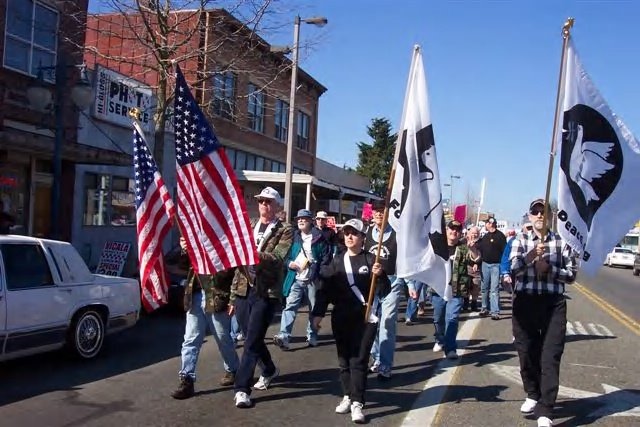
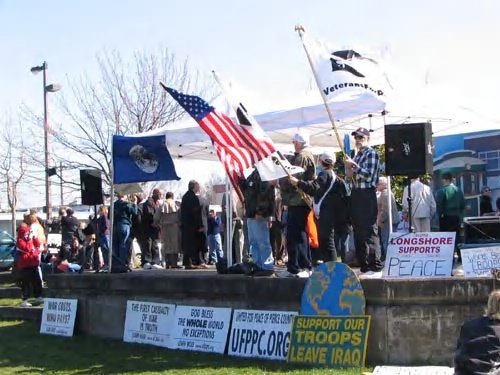
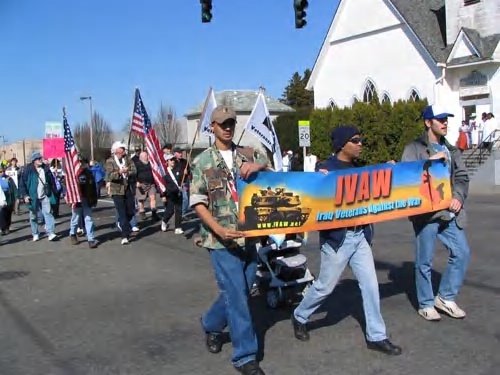
3rd anniversary war in Iraq/Afghanistan procession march in Tacoma, WA. Iraq Veterans Against the War led the march, followed by Veterans for Peace (above photo) followed by Military Families Speak Out, followed by faith communities, followed by Jobs with Justice labor unions, followed by other assorted peace and activitist coalitions of Tacoma, WA. 

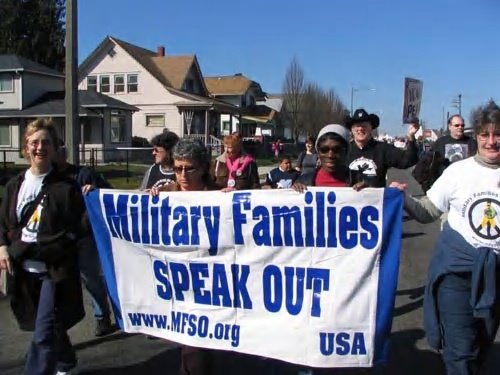
Military Families Speak Out contingent carry their banner behind Iraq Veterans Against the War, Veterans for Peace in the march in Tacoma, WA, march and rally March 19, 2006 - third anniversary war in Iraq/Afghanistan. Military Families Speak Out - WA chapter contingent. members; left - Judy Linehan; center - Cathy Schop; right - Lietta Ruger 
Posted by
Lietta Ruger
at
10:39 AM
0
comments
Links to this post
Labels: Lietta Ruger, military families speak out

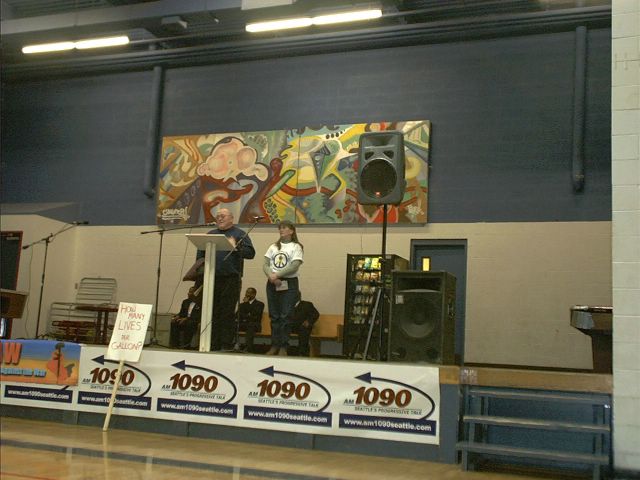
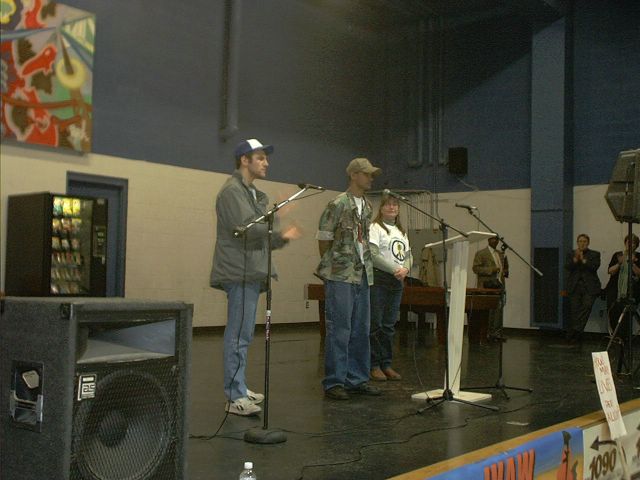
Gold Star father, Joe Colgan, and Lietta Ruger, Military Families Speak Out - Wa speak at third anniversary Iraq/Afghanistan war on March 19, 2006 inTacoma,WA, 
Posted by
Lietta Ruger
at
10:22 AM
0
comments
Links to this post
Labels: Lietta Ruger, military families speak out

Military Families Speak Out - Wa at march and rally on March 19, 2006 in Tacoma, WA. Jessie Archibald and Judy Linehan, of Military Families Speak Out- WA holding banner. 
Posted by
Lietta Ruger
at
10:16 AM
0
comments
Links to this post
Labels: Lietta Ruger, military families speak out
Community marches against war | TheNewsTribune.com | Tacoma, WA
M. ALEXANDER OTTO; The News Tribune
Published: March 20th, 2006 01:00 AM
About 1,000 people rallied Sunday in Tacoma’s Hilltop neighborhood to protest the Iraq war on the third anniversary of its beginning.
Church leaders, labor groups, soldiers, longshoreman, veterans, military families, politicians, professors, and others joined in opposition to the war with a march from People’s Park to People’s Center.
With speeches, signs, and discussions, they made their points: The Bush Administration misled the country into a needless war with false data about Iraq being a terrorist threat; the conflict is being funded by cutting essential education, housing and health care programs; and the war is unwinnable and should end as soon as possible.
Signs and buttons carried slogans like “think outside the Fox, impeach Bush,” “ignorance isn’t patriotic” and “support our troops … bring ’em home.” No one was there to argue the other side of the issue.
The demonstrators held several moments of silence for U.S. soldiers and others killed in the conflict.
Joe Colgan, of Kent, said his son, Army 2nd Lt. Benjamin J. Colgan, was killed by a roadside bomb in Baghdad in November of 2003 while serving in an artillery unit.
After what’s come out about the conflict, he said, the fact that more people aren’t protesting “drives me nuts.”
Lietta Ruger, whose son-in-law and nephew, both 28, are in the Army and facing additional time in Iraq, said she hoped her efforts would prevent other families from feeling the uncertainty and pain of having loved ones in Iraq.
An Iraq war veteran took the stage with her.
“I did nothing positive in Iraq,” said Joshua Farris, 24, who said he served as an Army cavalry scout during the war’s first six months.
Referring to the protest, he said, “This is the right side of it.”
State Rep. Jeannie Darnielle, D-Tacoma, read a litany of complaints about the Bush administration’s conduct of the war: “Convincing us Saddam was linked to 9/11 was wrong! Denying civil war is imminent is wrong!” she said to cheers.
“Every American is contributing at least $1,500 per person per year” to the war effort, said Warren Freeman, pastor at Allen African Methodist Episcopal Church in Tacoma and Associated Ministries board member. “Too much money is being spent on the war, and not enough on health care, education, and housing.”
The protest was sponsored by Associated Ministries, the Church Council of Greater Seattle and United for Peace in Pierce County.
Laura Karlin, who helps operate Tacoma Catholic Worker’s hospitality house in Hilltop, said, “this is our neighborhood, and this is where we are seeing the program cuts, especially in low-income housing, shelter, and health care.”
Posted by
Lietta Ruger
at
9:31 AM
0
comments
Links to this post
Labels: Lietta Ruger, military families speak out
Saturday, March 18, 2006
Military Families Speak Out on tragic 3rd Anniversary Iraq/Afghanistan war
By Lietta Ruger
Weekend of tragically marking the third anniversary Iraq/Afghanistan war. Some of the scheduled events of Military Families Speak Out - Washington state Chapter
We welcome friends and supporters of our message:
Support Our Troops
Bring Them Home Now
Take Care of them when they get home.
We've been busy in Washington state this month -
MFSO participation in events in Washington
Bellingham
WHAT: March and Rally
DATE: Friday, March 17
TIME: 3pm
PLACE: Bellingham Herald building, Chestnut and State Sts.
WHO: MFSO members will participate, including Anna Lawson whose son serves in the North Dakota National Guard and who has been deployed to Iraq.
CONTACT: mfsowa@swandeer.com
Port Angeles
WHAT: Rally and March
DATE: Saturday, March 18
TIME: noon
PLACE: Liberty Bell Veterans Park, 4th and Lincoln
WHO: MFSO member Jenny Keesey will be speaking, whose son is in the Army.
CONTACT: mfsowa@swandeer.com
Tacoma
WHAT: Cost of War Hits Home rally & march
DATE: Sunday, March 19
TIME: 1:30pm
PLACE: People's Park Tacoma, Martin Luther King Way & S. 9th St.
WHO: Lietta Ruger of Bay Center, WA, will speak. Lietta's son-in-law and nephew are both in the Army and served extended tours in Iraq; they now face the prospect of multiple tours in Iraq. Lietta brings her history as a military family spanning her childhood and early adult years, and as a young military wife during Vietnam.
CONTACT: mfsowa@swandeer.com
Louisiana
WHAT: March of Veterans, Military Families, and Survivors of Hurricane Katrina from Mobile AL to New Orleans, LA http://www.vetgulfmarch.org
DATE: 3/14 - 3/19
TIME: Rally in New Orleans, 3/19/06 10 AM
PLACE: Enter Armstrong Park (Congo Square) and begin the Rally Against War and
Injustice.
WHO: Members of Military Families Speak Out, including:
* Stacy Bannerman of Kent, Washington whose husband serves in the Washington Army National Guard, SFC Mortar Platoon, and served a year's tour of duty in Iraq. Upon return to the US, his Brigade were cut loose after a week of outprocessing, and they have gotten no post-deployment mental health counseling.
Seattle
WHAT:Sat March 18, silent vigil 9:20am Senator Cantwell fundraiser: the Palace Ballroom, 2100 5th Ave, Seattle.
WHO: Joe Colgan, veteran, military family and father of Benjamin Colgan, killed in Iraq in 2003. Military families, veterans, and citizen voters will gather behind one or two 3 ft. by 9 ft. banners (in front of the entrance to the fund raiser) with the following excerpt from Joe's Seattle PI op-ed piece:
"I write as a veteran who has a special love for our troops and their families, and as the father of Lt. Benjami! n Colgan, who was killed in action in Baghdad on Nov. 1, 2003... How many more Americans and Iraqis must perish or be maimed until the "stay-the-course" approach is discredited?
...It is time for Cantwell to help move the debate beyond pointless rhetoric by taking a clear position and holding public forums to promote a better understanding of the costs of this war and how to end it."
(See the full op-ed http://www.commondreams.org/views06/0202-30.htm )
This will be a solemn presence that conveys a clear message to both those attending the fund raiser and to the press.
Previous Military Families Speak Out events in March 2006 events noting this tragic 3rd year anniversary;
Seattle
WHAT: Meeting with KOMO 4 TV news representatives to discuss discuss with KOMO 4 their past and future news/media coverage of terrorism and war in Iraq these past 3 yrs = adequate or inadequate and why?
DATE: Friday, March 17, 2006
WHO: Backbone Campaign, Amy Lacenski of Military Families Speak Out
Tacoma
WHAT: Forum Speak Out for Military Community
DATE: Wednesday, March 1, 2006
PLACE: Tacoma Unitarian Church
WHO: Military Families Speak Out, Gold Star Families Speak Out, Veterans for Peace, Iraq Veterans Against the War and the Olympia Movement for Justice and Peace. Purpose was to reach out to military families of Fort Lewis.
Lietta Ruger, the state chapter coordinator
for Military Families Speak Out (MFSO), says that
"the aim of the forum is to engage with other military families in Washington in discussion of the war, the mission, and support for the deployed troops.
We hope to reach across division and splits and
find some common ground for both sides of the
discussion. We share in common the support of the
troops deployed and have reason to be proud of them."
Media coverage included invitation and interviews in Fort Lewis Ranger and Tacoma News Tribune.
Also TNT reporter was at the event; article in
TNT reporting on the event
Link to the national Military Families Speak Out calendar of events listing events with military families participating across the nation:
Posted by
Lietta Ruger
at
8:05 AM
0
comments
Links to this post
Labels: Lietta Ruger, military families speak out
Friday, March 17, 2006
1,000 more sailors expected to join ground forces in Iraq
The Seattle Times: Local News: 1,000 more sailors expected to join ground forces in Iraq:
read the article here in Seattle Times
Wednesday, March 15, 2006
U.S. to Send 700 More Soldiers to Iraq - 1st Armored
U.S. to Send 700 More Soldiers to Iraq: "U.S. to Send 700 More Soldiers to Iraq
By ROBERT BURNS, AP Military Writer 6 minutes ago
The U.S. military is dispatching an Army battalion of at least 700 soldiers to Iraq from their base in Kuwait to provide extra security during the holiday of Ashura, three military officers said Wednesday.
More broadly, a substantial number of U.S. and Iraqi security forces are being repositioned inside Iraq in anticipation of potential sectarian violence related to a Shiite Muslim pilgrimage this month involving the holiday, one official said.
The holiday pilgrimages are to holy sites in Najaf and Karbala, predominantly Shiite areas where the potential for sectarian violence would be of great concern. Increased attacks marked the celebration during 2004 and 2005.
The military moves, which have not been publicly announced, come amid a spike in sectarian violence and expectations that it likely will remain a problem as fractious Iraqi political leaders attempt to form a new government.
The decision to add the armored unit, perhaps for as little as 30 days, is in contrast to the Bush administration's hopes of substantially drawing down the U.S. military presence in Iraq this year. There are currently about 133,000 troops there.
It also comes amid administration efforts to persuade the American public that the war effort is succeeding. Opinion polls show faltering public support for the war.
A battalion of the 1st Armored Division, numbering between 700 and 800 soldiers, is moving into Iraq in the next few days, one officer said. The three officers who confirmed the moves spoke on condition of anonymity because it has not yet been officially announced.
Bryan Whitman, a senior Pentagon spokesman, said he could not confirm the moves. "I don't have anything to announce," he said, although he noted that Defense Secretary Donald H. Rumsfeld had said on Tuesday that U.S. commanders may decide they need to temporarily boost troop levels because of the pilgrimage.
"General Casey may decide he wants to bulk up slightly for the pilgrimage," Rumsfeld said, referring to Gen. George Casey, the top U.S. commander in Iraq. "And we're continuing to pull troops down. And we're continuing to shift our weight, as we've said, between the combat patrol aspects of it, over to the training and the equipping and providing the enablers."
Hundreds of people have been killed since the Feb. 22 bombing of a Shiite mosque in Samarra, creating concern that the country may be tipping toward civil war.
The mechanized infantry battalion that is being sent to Iraq is one of three from the 2nd Brigade, 1st Armored Division that originally were scheduled to deploy to Iraq but were instead held in Kuwait as a standby force in the event Casey decided he needed extra troops. It's not clear how long the battalion will remain in Iraq, the officers said.
Friday, March 10, 2006
Rep. John Murtha: Despite Another $67 Billion, Our Army is Broke and Badly Depleted |
The Blog | Rep. John Murtha: Despite Another $67 Billion, Our Army is Broke and Badly Depleted : "Despite Another $67 Billion, Our Army is Broke and Badly Depleted
This morning I spoke at a gathering of the National Newspaper Association regarding my strategy to redeploy our troops from Iraq on a scheduled timetable as soon as practicable. Iraq continues to be mischaracterized by the President as the center for the Global War on Terrorism. It is estimated that there are less than 1,000 Al Qaeda in Iraq. What is happening in Iraq is a civil war. It is Iraqis killing Iraqis and our troops are also targets.
We are depleting our resources in Iraq. Last night the House Appropriations Committee passed the President's supplemental request, providing an additional $67 billion for the continued military operations in Iraq and Afghanistan. With this supplemental, Congress will have appropriated nearly $450 billion for the war, running our federal deficit higher and higher while this country had a surplus when President George W. Bush took office.
The latest reports show that the war in Iraq has badly depleted essential equipment. I am particularly concerned about the National Guard, who have only a third of the equipment they need to respond to a catastrophic event in our own homeland, and much of that equipment is antiquated and worn out. If something were to happen domestically in the near future -- and it's not an 'if', it's a 'when' -- the Guard will be severely hampered. I have said before that our army is broke, hollow, and stretched thin. I am not talking about the soldiers; they are well trained and have accomplished their mission. I say this in regards to the equipment and my particular concern regarding the National Guard."
Wednesday, March 08, 2006
Most American troops are seeking Iraq exit strategy too
link Most American troops are seeking Iraq exit strategy too - baltimoresun.com
By Clarence Page
Originally published March 7, 2006
WASHINGTON // Pollster John Zogby says he has been asked by senior military brass to give a presentation at the U.S. Central Command in Florida about his firm's recent poll of American troops in Iraq. Good. The troops have said things their commanders need to hear - including their commander in chief.
Among them: 23 percent of the troops surveyed said they want to stay 'as long as they are needed,' President Bush's often-stated policy. Seventy-two percent of the respondents said the United States should leave Iraq within the next year, and that included a 29 percent minority who said the United States should pull out of Iraq 'immediately.'
As soon as the poll was released last week, commentators across the political spectrum rushed to their keyboards and microphones to distort the poll, inflating it or knocking it down to suit their agendas.
For the record, the poll that Zogby International conducted in conjunction with Le Moyne College's Center for Peace and Global Studies did not conclude that most American troops are 'begging to get out of Iraq,' as one blogger put it.
In a phone interview, Mr. Zogby said: 'We didn't ask them, 'When do you want to leave?' We asked when did they think U.S. troops should leave.' That was wise. If the question were about the troops as individuals, I'd be surprised if most of them did not want to leave 'yesterday.'
It is also significant to note that the Zogby poll showed Marines and regular Army troops to be more gung-ho about staying in-country indefinitely than reservists and National Guard members, who were called away from their hometowns like draftees.
Yet, with all that in mind, the poll results remind me eerily of ambivalent troop attitudes during the last days of the Vietnam War. I was drafted near the end of 1969. Americans had grown weary of that war by then, including those of us fighting it.
By then, the original mission was a vague memory. America seemed instead to be aimed at some vague goal that President Richard Nixon called "peace with honor." I never saw combat, by sheer luck, but the prevailing mission for many of my fellow troops had become simply keeping themselves and their buddies alive long enough to get home.
I hope the Zogby poll, conducted with the permission of field commanders at five bases in Iraq, does not reveal a similar sense of 11th-hour fatalism in today's troops, even though they appear to have ample reasons to feel that way.
Curiously, an overwhelming 85 percent said the U.S. mission in Iraq is mainly "to retaliate for Saddam Hussein's role in the 9/11 attacks." About 77 percent said they also believe the main or a major reason for the war was "to stop Saddam from protecting al-Qaida in Iraq."
That should come as news to President Bush, Vice President Dick Cheney and others who have said there's no credible evidence that Mr. Hussein had any role in 9/11.
Nevertheless, Team Bush often has pushed a double message, putting Mr. Hussein squarely in the middle of the "war on terror." That double message appears to have reached our troops, although not in a way that parrots administration policy. Only 24 percent gave "establishing a democracy that can be a model for the Arab world" as a major reason for the war.
It is more likely our troops are saying that they see themselves as engaged in a long-term war against terrorism and that Iraq is only one battlefront on which America is engaged. That sounds a lot like the way folks in my day saw Vietnam: It was a hot battlefront in our worldwide Cold War against Soviet communism.
Our side lost Vietnam but eventually won the Cold War. Iraq's future looks just as uncertain amid erupting signs of religious and ethnic civil war that have little to do with America's war against al-Qaida. We owe it to our troops to give them the support they need. But the success of their mission ultimately lies with the Iraqis. The longer we stay in Iraq, the more we become an impediment to Iraqi self-rule and targets for violent attacks. Our troops appear to be keenly aware of that. So should the rest of us.
Clarence Page is a columnist for the Chicago Tribune. His column appears Tuesdays and Fridays in The Sun. His e-mail is cptime@aol.com.
Sunday, March 05, 2006
Washington State Takes Reins to Support Returning Troops
partial cross post from ilona's blog...special tx to ilona for her blog with focus on our returning troops and their families.
Washington State Takes Reins to Support Returning Troops: "
From the Everett, Washington Daily Herald:
The effects of the war in Iraq are beginning to reverberate in the state Legislature. A state-funded treatment program for veterans suffering from post-traumatic stress disorder could receive an extra $170,000 this year, enough to serve another 130 soldiers should they need help when they return from Iraq. The funds are in a $500,000 package for the Department of Veterans Affairs in the budgets proposed by Gov. Chris Gregoire, the House of Representatives and state Senate.
Only Washington and New Jersey have state-funded PTSD treatment programs. Washington is the only state with an increasing number of veterans, said Tom Schumacher, who runs the Everett-based program. Other states rely solely on federal funding to maintain their PTSD programs and for helping soldiers readjust to civilian life, though many emotionally wounded veterans shy away from them, Schumacher said.
Of the 10,000 National Guardsmen and reservists already returned from combat duty to Washington state, Schumacher estimated that 4,000 of them will have readjustment issues or full-blown PTSD. 'Can we ever do enough? Probably not,' Schumacher said. Nevertheless, 'It's up to us to be the example of what should be done.'"
Haunted by the War on Terror
"Here is the link to the ABC news page...
The video is titled 'Haunted by the War on Terror'...
and will most likely by listed on the page for a week or so.
It is about a very special reintegration program for troops coming back from Iraq and Afghanistan.
It is an excellent report and well worth the three or so minutes it takes to watch it.
Below is the print version of the story:
---------------
Soldiers Describe 'Emotional Roller Coaster' Upon Return From War
Psychological Toll on Battle-Hardened Vets Complicates Switch to Civilian Life
By DEAN REYNOLDS
CLOQUET, Minn., — - The crowd inside the National Guard Armory at the Minneapolis-St.Paul airport looks kind of bleary-eyed. The 20 or so Minnesota Guardsmen have just returned home from a year in Afghanistan. They arrived just the night before, and not all are eager to be here.
But they've come anyway, along with their spouses and parents. It's Day One of their reintegration program.
'Morning everybody,' Chaplain Maj. John Morris says cheerily to the group. A few nod back. Others stare straight ahead, bracing for what will be two days of lectures, presentations and warnings.
In most of the country, the rule for National Guard members returning from war zones is to leave them alone for at least three months, while providing space and quiet time so they can reconnect with their families, their jobs, their communities. But here in Minnesota, the men and women back from war are expected to show up for these seminars immediately, and then return at 30-, 60- and 90-day intervals.
Maj. Gen. Larry Shellito is the father of the program, which works hard to address the emotional toll of returning from a war zone but also covers how to obtain federal benefits.
"We owe them," he said of the Guardsmen. "This country owes them to make sure that we can give them that box of tools to help them reintegrate and be successful." Leaving soldiers to their own devices for the first three months of their return, he believes, courts disaster.
"The ones that we just turn loose on society to fend for themselves," said Shellito, "those are the ones that I'm worried about because I don't know what support mechanisms they have."
Statistics indicate these battle-hardened veterans need all the help they can get. A groundbreaking study on the mental health of returning troops released this week indicates that fully one-third of those who served in Iraq during the first year of the war sought mental health services upon leaving the fighting. The war's succeeding years have been, if anything, more intense.
Published in the Journal of the American Medical Association, the study opens a window on the enormous psychological and emotional toll the conflict has taken on the men and women who are doing the fighting.
Incidents of drug use, gambling, sleepless nights, spousal abuse, crying spells or flashbacks to the battlefield are all on the rise among returning troops.
At the Guard armory in Cloquet, Minn., not far from Duluth, Sgt. Jason Brekke spoke of a concern that befalls many a vet who's had to run the gantlet of improvised explosive devices, or IEDs.
Soldiers Speak of Paranoia, Loneliness
"My third day home," Brekke said in an interview, "I seen a bag on the side of the road and I about wanted to jump out of the car because instantly you're thinking roadside bomb."
Sgt. Joseph Seppa said loneliness was an issue. "You know, you're used to being around several hundred soldiers all the time and you come back and now all of a sudden you're alone. It's a little bit different. It's hard to loosen up and relax and actually realize that you're home."
Back at the armory in Minneapolis, a bullish Guard member in uniform clears his throat and speaks.
"What you're about to go into is no different than a combat zone," said Sgt. Ron "Keith" Huff. "I'm telling you it's harder and more dangerous here." Huff should know. He's been struggling with re-entry for more than a year since returning from Iraq.
"It's easier to admit that you were shot in the leg or that you were sick, you know, or that you had the flu than it is to say, 'You know, I'm not feeling well today. I'm a little depressed,'" Huff told the group of Guardsmen.
Since September Huff has served as Exhibit A of the pitfalls soldiers can face. He describes, for example, how he became disoriented at a local hardware store and began threatening a teenage clerk, how he gets spooked by his wife who moves around their house too quietly for comfort, how he reacts when he sees anyone who may just look Middle Eastern.
"OK," he tells himself, "We're not in Iraq. [He] probably doesn't have a bomb strapped to him. He's probably not going to kill me -- today."
Huff has turned his harrowing experiences into a warning lecture that he delivers regularly to returning Guardsmen, like these in the airport armory.
"I don't know that the public understands," he said in an interview during a break in his presentation. "How can they? And I don't know that they want to know."
Huff is aided by Chaplain John Morris. Referring to the public, Morris said, "They don't understand that for most of us, the war is just starting [when we return]."
'A Big Emotional Roller Coaster'
Then, to the families in attendance, Morris warned, "I don't know if I can fully explain this to you, but this is not the same person that left a year ago or two years ago. As they flip back from warrior to citizen," Morris continued, "it's going to be a big, big, big emotional roller coaster."
Morris and Huff agreed that if it takes months of preparation to create a warrior out of a civilian, it should take months to turn a warrior back into a civilian. Because, as Morris explained, "We're going to take you out of the very intense environment of the military. We're going to return you to a civilian world that does not understand you and, in fact, has lost interest in where you were."
The assembled Guardsmen say they get it.
Asked if he expects to make a seamless transition to civilian life, Sgt. Rod Haworth said, "No absolutely not. It won't be for any of us."
Katie Overland's husband, Maj. John Overland, is in the group that returned from Afghanistan. She worries about the national mood as the war drags on. "They think the soldier comes home and it's over. But it's not over."
The Minnesota plan has another feature that sets it even further apart. Huff and Morris will make presentations to community leaders as well, to alert them to the potential problems returning veterans may pose to them and their towns.
"If we do a good job reintegrating our combat vets and helping their families," Morris said in an interview, "we're going to have a tremendous citizen here.
"But if we don't. If we repeat what we did in Vietnam and shun or, at worst, shame these veterans, we're going to drive people underground. They're going to manifest terrible problems."
Bruce Ahlgren, the mayor of Cloquet, attended the community briefing a few days ago and said it was an eye-opener.
"We just kind of think they come back and they're in a comfort zone again and everything's hunky-dory." That's clearly not the case, Ahlgren acknowledged. And the words of Chaplain Morris still rang in his ears.
"Please be respectful and welcome us and show hospitality," he told the Cloquet city leaders, "until we get our feet on the ground.




Ehren Watada with Daniel Ellsberg

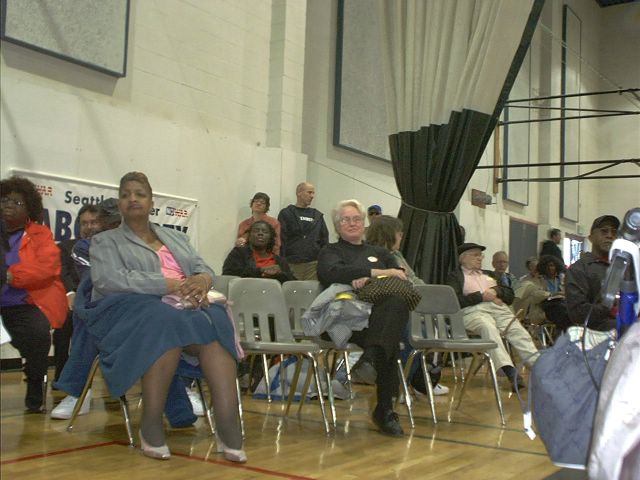
Lietta in support of Lt. Ehren Watada at his first press conference, June 2006, Tacoma, WA. Photograph: Ted S Warren/AP