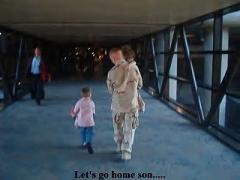
We are a military family with 2 returning Iraq veterans; OIF, March 2003 - August 2004, He deployed to Iraq in his second stop-loss extended 15 month deployment; Dec 2007 - April 2008. Now he has standing orders for deployment to Afghanistan. I believe it is a sacrifice too large to ask of him, his wife and their three children. 'Let's go home son' is how we captioned the photo
She really did. She phoned on Veterans Day. I was sitting at my desk in my home in my lounge around the house clothes, working on my laptop. The dawning of the fullness of the recognition that I was on the phone listening to Michelle Obama, who will very soon be the First Lady hit me like a ton of bricks and blew me away. Wow, I'm on a phone call with the First Lady -- how cool is that!
Actually, it was a conference call, listen only, that Michelle Obama made on Veterans Day to Blue Star Families 4 Obama, to thank them for their pro-active help in the campaign, to thank them for their sacrifices as military families. We are a Blue Star family and I had joined the BSF4O group during the campaign at my mybarackobama campaign site.
So no, it was not a personal call specifically to me, and I was having a little fun with the first part of this post. Still, I was surprised at my own reaction and recognition -- this really is Michelle Obama, she really will be the First Lady, she is talking to us on a phone conference call, talking about her daughters, getting them into schools, getting ready for the inauguration. It had a surreal feeling to it for me. I am not used to being on a phone call from the First Lady and well, the Vice President -- an earlier conference call I got to participate in (listen only) with Joe Biden.
If I were to be on a phone conference call with President Elect, Barack Obama, based on my reaction to Michelle Obama's phone conference call, I'm sure my reaction will cause my heart to beat faster.
Towards the end of the campaign, I was on a listen only conference call from Joe Biden that he set up via his email listserv. He had just concluded his speech in Tacoma, WA, thanked us and was encouraging the many of us on the conference call to get out there and keep working, and not to take anything for granted.
Returning wounded Iraq veteran, and now Director of the Illinois Dept of Veteran’s Affairs, Tammy Duckworth who lost both legs in combat in Iraq war with President Elect, Barack Obama on Veteran’s Day 2008; ceremony of placing the wreath on Bronze Soldiers Memorial.
Released in 2008, the film ‘Crawford’ produced/directed by David Modigliani is a documentary/biography of the small town of Crawford, Texas before George W. Bush arrived at their doorstep, during the time of his Presidency. (And now after as new President-Elect, Barack Obama, is preparing to assume the office of President of the United States). The film,’Crawford’ is put together in a way that shows the residents of the town, their lives, and the impact of what happens to the town and their lives when George Bush moves to their town to set up his ranch in his campaign for President.
The video is embedded below, obtaining it from and assuming that Hulu has necessary permissions to share it online. If the video does not work at my blog, you can view it where I did, online at his link – Hulu.
I jump ahead of the film, to my own personal experience of Crawford, Texas. Of course, part of the Crawford experience is that month of August 2005, when Cindy Sheehan parked herself in Crawford outside the President’s ranch during his vacation. For perspective as to why Cindy decided to make her stand at that time, remember that President Bush took vacation shortly after one of his press conferences in which he identifies the deaths of troops in Iraq as having given their lives for a noble cause.
Remember that at that time, 23 marines from the Lima Company alone had been killed in Iraq in 2005, 20 were killed over 2 days in August 2005 – six on Aug 1, and fourteen on Aug 3. Cindy, mother of Casey Sheehan, soldier, who was killed in Iraq April 4, 2004, deliberately went to Crawford almost immediately after the noble cause statement to ask George Bush personally ‘What Noble Cause?’ . While the film does not elevate this period of the George Bush ranch in Crawford experience,the film attempts to show the impact on local residents.
I was part of that story, part of that August 2005 experience of Crawford. Since I was not or did not consider myself to be a ‘peace activist’ prior to the Iraq war but chose to present as a military family trying to speak out to a new young generation of military families, the perspectives I have of my own experiences among the peace/activism communities has it’s own unique flavor. My experience of Crawford, Texas, Camp Casey, August 2005 is colored by my experiences growing up as what is affectionately callled a ‘military brat’ on military bases in between the Korean Conflict (war) and the Vietnam war, my experiences as a military wife of a young husband, drafted and deployed to Vietnam, my experiences living in the ‘military culture’, my professional career employment in the social services field during my adult years as a civilian employed in state level public sector, and my inexperience with the culture of peace/activism communities.
The film does justice to one of the many considerations I had when I was at Crawford. How does this tiny town cope with having such high profile people make their mark at Crawford? How does the town deal with and cope with the polarized, political battle of opinions here at home on the Iraq war which I believe came to head at Crawford during Camp Casey in August 2005. Now that I actually do live in a small town, and it is a new part of my life experiences, I wondered how the people in the town where I live would react should something similar happen in their town and lives.
Whatever came after the August 2005, Crawford, Texas, Camp Casey experience, I will always credit Cindy with bringing to head the public discourse which at that time had been embroiled in political limitations to the language of what constitutes patriotism, the flag, and support for the troops. The public political discourse needed to happen and the shift in the political discourse because of that month of August 2005 in Crawford that gave voice to the many-faceted feelings and opinions of the war in Iraq needed to happen.
It opened doors within the public Iraq war political discourse that had been previously deliberately slammed shut. And I would offer those doors were slammed shut with deliberate forethought and premeditation so as to confine, undermine, and squelch any opportunity of public dialogue or public dissent. For myself, an ordinary person living an ordinary life, my experience of August 2005 in Crawford, Texas was extraordinary and has marked me indelibly.
But August 2005 is not the point of this film, it is a part of the film, as it is a part of the Crawford experience. The film is presented in a way that does not favor opinions about the Iraq war, about George W. Bush, but brings to bear the experience of both along with other experiences that often times typifies small town America. The ending of the film shook me up – was something I did not know and was very unsettling.
I hope you’ll watch the film. It is not a trailer, but the full length film, 1 hour and 15 minutes, so recommend watching it when you have some time to watch it.
Excerpt of one review of the film ‘Crawford’ by Joe Leydon at Variety
By JOE LEYDON David Modiglinai's "Crawford" offers an evenhanded and occasionally poignant account of the impact on the citizenry of the small Texas town chosen by President George W. Bush to be the site of his so-called "Western White House." Filmed over several years, docu plays like a rise-and-fall drama populated with colorful, contrasting characters who have profoundly mixed feelings about being used as props in Bush's political stagecraft. After a spin on the fest circuit, pic might get limited theatrical play before pubcast and/or niche-cable airdates.
WASHINGTON – It takes a brave soldier to do what Army Maj. Gen. David Blackledge did in Iraq.
It takes as much bravery to do what he did when he got home.
Blackledge got psychiatric counseling to deal with wartime trauma, and now he is defying the military's culture of silence on the subject of mental health problems and treatment.
"It's part of our profession ... nobody wants to admit that they've got a weakness in this area," Blackledge said of mental health problems among troops returning from America's two wars.
"I have dealt with it. I'm dealing with it now," said Blackledge, who came home with post-traumatic stress. "We need to be able to talk about it."
As the nation marks Veterans Day on Tuesday, thousands of troops are returning from Iraq and Afghanistan with anxiety, depression and other emotional problems.
As many as one-fifth of the more than 1.7 million who have served in the wars are estimated to have symptoms. In a sign of how tough it may be to change attitudes, roughly half of those who need help are not seeking it, studies have found.
Despite efforts to reduce the stigma of getting treatment, officials say they fear generals and other senior leaders remain unwilling to go for help, much less talk about it, partly because they fear it will hurt chances for promotion.
That reluctance is also worrisome because it sends the wrong signal to younger officers and perpetuates the problem leaders are working to reverse.
"Stigma is a challenge," Army Secretary Pete Geren said Friday at a Pentagon news conference on troop health care. "It's a challenge in society in general. It's certainly a challenge in the culture of the Army, where we have a premium on strength, physically, mentally, emotionally."
Adm. Mike Mullen, chairman of the Joint Chiefs of Staff, asked leaders this year to set an example for all soldiers, sailors, airmen and Marines: "You can't expect a private or a specialist to be willing to seek counseling when his or her captain or colonel or general won't do it."
Brig. Gen. Loree Sutton, an Army psychiatrist heading the defense center for psychological health and traumatic brain injury, is developing a campaign in which people will tell their personal stories. Troops, their families and others also will share concerns and ideas through Web links and other programs. Blackledge volunteered to help, and next week he and his wife, Iwona, an Air Force nurse, will speak on the subject at a medical conference.
A two-star Army Reserve general, 54-year-old Blackledge commanded a civil affairs unit on two tours to Iraq, and now works in the Pentagon as Army assistant deputy chief of staff for mobilization and reserve issues.
His convoy was ambushed in February 2004, during his first deployment. In the event that he since has relived in flashbacks and recurring nightmares, Blackledge's interpreter was shot through the head, his vehicle rolled over several times and Blackledge crawled out of it with a crushed vertebrae and broken ribs. He found himself in the middle of a firefight, and he and other survivors took cover in a ditch.
He said he was visited by a psychiatrist within days after arriving at Walter Reed Army Medical Center in Washington. He had several sessions with the doctor over his 11 months of recovery and physical therapy for his injuries.
"He really helped me," Blackledge said. And that's his message to troops.
"I tell them that I've learned to deal with it," he said. "It's become part of who I am."
He still has bad dreams about once a week but no longer wakes from them in a sweat, and they are no longer as unsettling.
On his second tour to Iraq, Blackledge traveled to neighboring Jordan to work with local officials on Iraq border issues, and he was in an Amman hotel in November 2005 whensuicide bombers attacked, killing some 60 and wounding hundreds.
Blackledge got a whiplash injury that took months to heal. The experience, including a harrowing escape from the chaotic scene, rekindled his post-traumatic stress symptoms, though they weren't as strong as those he'd suffered after the 2004 ambush.
Officials across the service branches have taken steps over the last year to make getting help easier and more discreet, such as embedding mental health teams into units.
They see signs that stigma has been slowly easing. But it's likely a change that will take generations.
Injured Iraq war veteran, Tomas Young, is the featured centerpiece of this documentary produced by well known talk show host, Phil Donahue, and Ellen Spiro. Songs by Eddy Vedder. The documentary has won National Board of Review award for Best Documentary. The documentary follows 3 years of the life of Tomas Young upon his return from Iraq after being injured. Tomas' spine was severed by a sniper's bullet within a week of arriving in Iraq, leaving him paralyzed for life from the chest down at the tender young age of 25.
Phil Donahue has been passionate in making and promoting this documentary, giving considerable credit to Ellen Spiro for her untiring work on the film.
Quoting Phil Donahue; "Tomas Young is one of thousands of returning veterans forced to adjust to serious changes in their lives in the wake of this war, and it's critical that their stories get out there."
On a more personal level, I have seen the film, and while I did not personally meet Tomas, I am aware of him, spent some time in some of the same locations shown in the documentary. I recognize several of my military family colleagues shown in the film, was there with them at the time of this documentary filming. I feel as if I know Tomas, after all, he and other's like him are why I have committed these past almost six years as a military family speaking out against sending this young generation into an unwarranted war in Iraq.
I can't think of a more appropriate film showing on this Veteran's Day than one that acknowledges all of our returning and not returning Iraq veterans. While Veteran's Day is about all veterans of all engagements, I know the older veterans are honored and humbled to have this young generation of Iraq veterans acknowledged.
BAGHDAD — Barack Obama may have been elected only three days ago, but his victory is already beginning to shift the political ground in Iraq and the region.
Iraqi Shiite politicians are indicating that they will move faster toward a new security agreement about American troops, and a Bush administration official said he believed that Iraqis could ratify the agreement as early as the middle of this month.
“Before, the Iraqis were thinking that if they sign the pact, there will be no respect for the schedule of troop withdrawal by Dec. 31, 2011,” said Hadi al-Ameri, a powerful member of the Islamic Supreme Council of Iraq, a major Shiite party. “If Republicans were still there, there would be no respect for this timetable. This is a positive step to have the same theory about the timetable as Mr. Obama.”
Mr. Obama has said that he favors a 16-month schedule for withdrawing combat brigades, a timetable about twice as fast as that provided for in the draft American and Iraqi accord.
and this;
Over all, however, there was a new tone of optimism. “The atmosphere is positive with the American attempt to preserve the sovereignty of the Iraqi nation,” the government’s spokesman, Ali al-Dabbagh, told the news channel Al Arabiya. He praised the inclusion of a new provision stating that Americans would not launch attacks on Iraq’s neighbors from Iraqi soil.
The Americans also added language to make explicit what kinds of troops would remain after the withdrawal in 2011, said a Bush administration official knowledgeable about the security pact. Those still in Iraq would be primarily trainers and air traffic controllers, the official said.
“There’s going to be a significant presence, but they are not going to be ‘combat’ forces,” said the administration official. The official said that the most recent talks with Iraqis had given American negotiators confidence that a final agreement was close.
Mr. Ameri, who is chairman of the security committee of Iraq’s Parliament, said that Iraqi politicians did appreciate the Bush administration’s commitment to Iraq. Signing the agreement while President Bush was still in office would be “a minimum sign of appreciation,” Mr. Ameri said.
Following through on his campaign promises, President Elect, Barack Obama and Vice President Elect, Joe Biden already have a strong sense of how they plan to end the war in Iraq.
Read the entire article by Jason Leopold at The Public Record.
also read it firsthand at and follow along at Barack Obama’s newly launched online ‘transition’ website change.gov – office of the President-Elect.
The president-elect said one of his first policy directives after he is sworn into office will be giving military commanders and the Secretary of Defense "a new mission in Iraq: ending the war."
On the SOFA; which needs to be worked out between the U.S. and Iraq by Dec 31, 2008 since that is when the United Nations mandate that allows foreign soldiers to operate in country expires
"Under the Obama-Biden plan, a residual force will remain in Iraq and in the region to conduct targeted counter-terrorism missions against al Qaeda in Iraq and to protect American diplomatic and civilian personnel," his proposal says. "They will not build permanent bases in Iraq, but will continue efforts to train and support the Iraqi security forces as long as Iraqi leaders move toward political reconciliation and away from sectarianism."
The Obama team also said that a Status of Forces Agreement Bush is currently negotiating with the Iraqi government must be approved by Congress or must include input from Obama and his foreign policy advisers before being signed.
“The Bush administration must submit the agreement to Congress or allow the next administration to negotiate an agreement that has bipartisan support here at home and makes absolutely clear that the U.S. will not maintain permanent bases in Iraq," according to Obama’s transition website.
"Obama and Biden believe any Status of Forces Agreement, or any strategic framework agreement, should be negotiated in the context of a broader commitment by the U.S. to begin withdrawing its troops and forswearing permanent bases," states the proposal. "Obama and Biden also believe that any security accord must be subject to Congressional approval. It is unacceptable that the Iraqi government will present the agreement to the Iraqi parliament for approval—yet the Bush administration will not do the same with the U.S. Congress.”